From the Council on Foreign Relations Web site:
IRAN’S NUCLEAR STAND SPLITS IAEA
Debate continues at the International Atomic Energy Agency (IAEA) over a resolution drafted by the European Union to refer Iran to the UN Security Council over its suspect nuclear program. Iran, which insists its nuclear program is for peaceful purposes only, warns it would view the IAEA’s adoption of the resolution as a “confrontation.”
Gary Sick tells CFR’s Bernard Gwertzman the U.S. should consider bilateral talks with Iran; the Council’s Iran expert Ray Takeyh testifies on Iran’s nuclear program and tackles Tehran’s strategy in another Gwertzman interview; and our Background Q&A reviews Iran’s nuclear stance. President Ahmadinejad presents his country’s case for nuclear power in a UN address (PDF), as the U.S. State Department outlines its case against Tehran in this brief (PDF).
Non-proliferation Treaty EU-Iran 2004 Agreement (PDF)
Friday, September 23, 2005


Iran: Promises, Promises
I just got this note from the author of "We Are Iran: The Persian Blogs," who writes under the name of Nasrin Alavi. It's one of the most interesting takes I've seen on Iran's nuclear posturing:
Europe’s strategy of offering Iran the carrot of engagement - rather than the stick of regime change and war -- appears to be gradually crumbling away. Iran is emboldened by soaring oil prices and US entanglements in Iraq and Afghanistan. It is also banking on the energy needs of Russia, China and India, with which it has fostered growing economic ties. Bowing to Russian and Chinese pressure, the European Union has for now backed off from a demand that the UN nuclear watchdog should report Iran to the Security Council.
President Ahmadinejad’s asserted at the 2005 U.N. General Assembly that Iran has an "inalienable right" to operate a nuclear power program. Europe and the United States took this as a sign of defiance. Yet there are also strong signals that Tehran wants to talk directly to the US and may feel that she can now engage with the US from a position of strength. Public announcements by many of Iran’s leading hardliners that Iran should pursue a ‘Chinese model’ of governance would mean liberalizing the economy and making peace with Europe and the United States – while maintaining political repression.
Iran’s eerie amorous offensive towards the US at the World summit appears to have gone completely unnoticed by Western audiences. Ahmadinejad is the first Iranian president for a quarter of a century who has had the go-ahead from Tehran to join World Summit leaders at their final photo call, thereby breaking the taboo of being photographed with the leaders of the US and Israel. Muhammad-Ali Abtahi, an ex-vice-president of the Iranian parliament describes in his blog how five years earlier ex-president Khatami, “aware of many consequences,” had refused to take part in such a photo.
Ironically, representatives of Iran’s hard-line parliament accompanying Ahmadinejad were muzzled as Tehran tried to put an amiable spin on Ahmadinejad’s visit to the UN. Mehranghiz Marouti, one of the MP’s, told the Aftab Daily on her return to Iran, “We expected to be able to put forward our viewpoints to the press, but did not have permission from Tehran.”
In a Newsweek interview when asked about US-Iran relations, Ahmadinajad declared that Iran, “would like to have relationships that are equal and just with all countries in the world.” This surpasses anything an Iranian President has ever uttered in reference to US relations. Yet regardless of what Ahmadinejad insisted in another US interview, “access to the nuclear supply process” was never an “election slogan” by him or any of the other prospective presidential candidates. And despite Tehran’s’ cocky attitude, Ahmadiinejad knows that his actual election platform of distributing oil wealth amongst the poor may come to nothing if Iran is isolated.
During his election campaign Ahmadinejad was promoted as the man of the people. He tapped into the vein of popular anger against corruption and cronyism. He appealed to the minds and hearts of jobless youth and underpaid workers promising food and housing subsidies for the poor. With hindsight, it seems anyone standing in the second round against the “corrupt Rafsanjani clan” was bound to become president. I was amazed at the number of people in Iran who told me that they had voted ‘tactically’ against Rafsanjani.
According to Behzad Nabavi, acting chairman of parliament during Khatami’s era, the modest looking mayor of Tehran backed by the establishment ‘was promoted as an anti-establishment figure.’ At one stage during his campaign Ahmadinejad even falsely complained that the ‘establishment’ had cut off the electricity supplies of large areas of Iran so that his campaign speeches promising a fight against corruption could not be heard by the ordinary people.
Ahmadinejad comes from and is endorsed by the hard-line core of the regime that has ultimately controlled power in Iran since the revolution. Ahmadinejad’s possible inability to keep his campaign promises in the next four years will be a critical challenge to the heart of Iran’s revolutionary elite.
Europe’s strategy of offering Iran the carrot of engagement - rather than the stick of regime change and war -- appears to be gradually crumbling away. Iran is emboldened by soaring oil prices and US entanglements in Iraq and Afghanistan. It is also banking on the energy needs of Russia, China and India, with which it has fostered growing economic ties. Bowing to Russian and Chinese pressure, the European Union has for now backed off from a demand that the UN nuclear watchdog should report Iran to the Security Council.
President Ahmadinejad’s asserted at the 2005 U.N. General Assembly that Iran has an "inalienable right" to operate a nuclear power program. Europe and the United States took this as a sign of defiance. Yet there are also strong signals that Tehran wants to talk directly to the US and may feel that she can now engage with the US from a position of strength. Public announcements by many of Iran’s leading hardliners that Iran should pursue a ‘Chinese model’ of governance would mean liberalizing the economy and making peace with Europe and the United States – while maintaining political repression.
Iran’s eerie amorous offensive towards the US at the World summit appears to have gone completely unnoticed by Western audiences. Ahmadinejad is the first Iranian president for a quarter of a century who has had the go-ahead from Tehran to join World Summit leaders at their final photo call, thereby breaking the taboo of being photographed with the leaders of the US and Israel. Muhammad-Ali Abtahi, an ex-vice-president of the Iranian parliament describes in his blog how five years earlier ex-president Khatami, “aware of many consequences,” had refused to take part in such a photo.
Ironically, representatives of Iran’s hard-line parliament accompanying Ahmadinejad were muzzled as Tehran tried to put an amiable spin on Ahmadinejad’s visit to the UN. Mehranghiz Marouti, one of the MP’s, told the Aftab Daily on her return to Iran, “We expected to be able to put forward our viewpoints to the press, but did not have permission from Tehran.”
In a Newsweek interview when asked about US-Iran relations, Ahmadinajad declared that Iran, “would like to have relationships that are equal and just with all countries in the world.” This surpasses anything an Iranian President has ever uttered in reference to US relations. Yet regardless of what Ahmadinejad insisted in another US interview, “access to the nuclear supply process” was never an “election slogan” by him or any of the other prospective presidential candidates. And despite Tehran’s’ cocky attitude, Ahmadiinejad knows that his actual election platform of distributing oil wealth amongst the poor may come to nothing if Iran is isolated.
During his election campaign Ahmadinejad was promoted as the man of the people. He tapped into the vein of popular anger against corruption and cronyism. He appealed to the minds and hearts of jobless youth and underpaid workers promising food and housing subsidies for the poor. With hindsight, it seems anyone standing in the second round against the “corrupt Rafsanjani clan” was bound to become president. I was amazed at the number of people in Iran who told me that they had voted ‘tactically’ against Rafsanjani.
According to Behzad Nabavi, acting chairman of parliament during Khatami’s era, the modest looking mayor of Tehran backed by the establishment ‘was promoted as an anti-establishment figure.’ At one stage during his campaign Ahmadinejad even falsely complained that the ‘establishment’ had cut off the electricity supplies of large areas of Iran so that his campaign speeches promising a fight against corruption could not be heard by the ordinary people.
Ahmadinejad comes from and is endorsed by the hard-line core of the regime that has ultimately controlled power in Iran since the revolution. Ahmadinejad’s possible inability to keep his campaign promises in the next four years will be a critical challenge to the heart of Iran’s revolutionary elite.
Thursday, September 22, 2005
Iraq: How to Get Out
Excerpts from a Saudi friend's letter:
If an American withdrawal were handled professionally and methodically, the chances of seeing a united Iraq may indeed grow, hence ostensibly benefiting the Iraqi people and the future of their country. Let us say that the Americans go to the UN with a fixed timetable and a declared policy to withdraw their troops while safeguarding Iraq. Coalition troops would be replaced in phases by UN-sanctioned troops from acceptable countries. A UN Resolution would emphasize the territorial integrity of Iraq and guarantee Iraqis, through the Security Council and the General Assembly, with all the international aid and support they may need.
In such a scenario it seems more likely that Shias, Sunnis and Kurds, faced with the shared determination of the international community and the help of their neighbors, would be ready to work responsibly towards filling a new vacuum rather than engaging in sectarianism and divisive politics. Such a consensus is already supported by the Iraqi people and neighboring countries, all strongly in favor of a united Iraq. The proposed scenario will of course leave many questions unanswered, but it seems a better alternative than American troops staying in Iraq to watch Iraqis die and a country disintegrate....
Americans do not like comparing the situation in Iraq to the one they faced in Vietnam. But on one crucial point, the comparison may be necessary. Withdrawing from Iraq may be a temporary embarrassment and setback for the United States, but this is due to an initially flawed policy, while withdrawal seems to be eminently sensible policy. America would also be strengthening its position at the UN and adding to the UN’s capacity to resolve similarly complicated disputes with steadfastness and adequate means. At the end of the day America will be a winner. It will be showing the world that it is able to correct flawed policy, to lead wisely, and to work for the best interests of all.
If an American withdrawal were handled professionally and methodically, the chances of seeing a united Iraq may indeed grow, hence ostensibly benefiting the Iraqi people and the future of their country. Let us say that the Americans go to the UN with a fixed timetable and a declared policy to withdraw their troops while safeguarding Iraq. Coalition troops would be replaced in phases by UN-sanctioned troops from acceptable countries. A UN Resolution would emphasize the territorial integrity of Iraq and guarantee Iraqis, through the Security Council and the General Assembly, with all the international aid and support they may need.
In such a scenario it seems more likely that Shias, Sunnis and Kurds, faced with the shared determination of the international community and the help of their neighbors, would be ready to work responsibly towards filling a new vacuum rather than engaging in sectarianism and divisive politics. Such a consensus is already supported by the Iraqi people and neighboring countries, all strongly in favor of a united Iraq. The proposed scenario will of course leave many questions unanswered, but it seems a better alternative than American troops staying in Iraq to watch Iraqis die and a country disintegrate....
Americans do not like comparing the situation in Iraq to the one they faced in Vietnam. But on one crucial point, the comparison may be necessary. Withdrawing from Iraq may be a temporary embarrassment and setback for the United States, but this is due to an initially flawed policy, while withdrawal seems to be eminently sensible policy. America would also be strengthening its position at the UN and adding to the UN’s capacity to resolve similarly complicated disputes with steadfastness and adequate means. At the end of the day America will be a winner. It will be showing the world that it is able to correct flawed policy, to lead wisely, and to work for the best interests of all.
Five Stars in the Green Zone

The Hotel Rasheed, in Baghdad's Green Zone, is a five-star dump, pocked with holes left by rocket fire on one side, vulnerable to snipers on the other. The best hotels outside the Green Zone are mostly worse -- and even easier targets. (See reviews.) But the Iraqi press reports that help is on the way for those who want luxury in the middle of a war zone: the Ministry of Housing and Construction is planning a 23-story hotel with all the amenities. This will make life easier for visiting contractors and Congressional delegations, no doubt. What it will do for the hearts and minds of Iraq's people, hundreds of whom have been killed and maimed while waiting in line at the various entrances to the Green Zone, is less certain.
Last year the technocrat mayor of Baghdad, Alaa al-Tamimi, wanted to open up the Green Zone and revitalize the heart of the city. He was overruled by the terrorists and by the Americans, and finally deposed in what amounted to a coup by the Supreme Council for the Islamic Revolution in Iraq, which now rules the Baghdad badlands outside the Green Zone, with the help of U.S. troops. - CD
Wednesday, September 21, 2005
History: Nazi Chocolate Bar
The British National Archives offer a steady stream of revelations about the eccentricities of espionage:

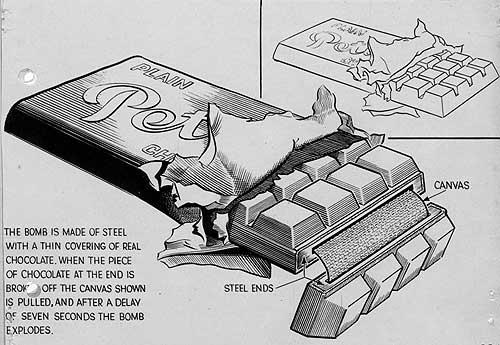
MI5 files reveal secrets of exploding chocolate bars
"Chocolate bombe"
Newly released files reveal German techniques for camouflaging sabotage equipment (KV4 /284)- these include drawings and photographs of an exploding chocolate bar and a mess tin concealing bomb equipment. Original German propaganda leaflets (KV3/210) feature a spoof Evening Standard article and a peculiar document claiming to have been issued by supporters of Hitler in Whitehall that sets out the fate of England after it is defeated.
The full inventory of disguised weapons dreamed up by the Germans for their secret agents is not just an amusing bit of James-Bondian fantasy from the past, it's a cautionary set of precedents for terrorism today:
KV 4/283 (1940-1941) – bombs disguised as a tea canteen, a can of peas, a suitcase, a mess tin, a can of motor oil, a thermos flask; detonators disguised as a pen and pencil set, a torch battery, shaving soap and a shaving brush, a tin of talcum powder, a clothes brush; toilet soap; a fuse hidden in a leather belt.
KV 4/284 (1942-1943) – bombs disguised as lumps of coal, a can of motor oil, a booby-trapped attaché case, a car battery, a can of cleaning polish, firelighters, throat pastilles, a tin of cassoulet and a tin of Smedley’s English red dessert plums; a hand-grenade disguised as a slab of eating chocolate.
KV 4/285 (1943-1945) – bombs disguised as a grinding stone, a belt, the heels and soles of a boot, a bolt-head, a tin of chub in tomato sauce, and a tin of Australian fruit salad.
Quiet Americans
"He was as incapable of imagining pain or danger to himself as he was incapable of conceiving the pain he might cause others."
-- Graham Greene, "The Quiet American"
I have never been able to read that line without thinking of President George W. Bush and the many well-intentioned Americans who support him. Greene understood the terrible danger of naive good will. I pointed this out before the Iraq invasion, in the hope it might make a difference. Vain hope. - CD
-- Graham Greene, "The Quiet American"
I have never been able to read that line without thinking of President George W. Bush and the many well-intentioned Americans who support him. Greene understood the terrible danger of naive good will. I pointed this out before the Iraq invasion, in the hope it might make a difference. Vain hope. - CD
Rules of Engagement
Another vivid on-scener from Newsweek's Michael Hastings in Iraq, "A Daily Dance with Death," 20 September 2005:
'...The long day is winding down. Dusk falls and the temperature drops. A half dozen Marines pull up chairs outside the house, in the fluorescent glow of "chem" lights—civilian campers call them glow sticks. These young Americans don't want to get blown up, they want to go home. And they don't want to kill civilians. They talk about the rules of engagement, stricter than when they fought in Iraq in 2004. That was "the Wild West," says Aziz. A recent shooting left a nasty impression, he recalls. A car carrying two women, two men and two kids failed to stop at the extensive barriers before the checkpoint at OP2. The driver ignored both warning signs and the multiple concrete blocks. The car came forward even after the tires were shot out. Eventually, a Marine opened fire. The two women were killed. The bullets blew the back of one woman's head off, says Franklin, adding: "It was even worse than the s—- I saw last time I was here." But the enemy knows the Marines can't fire first. Lately, the Marines say, cars probe the defenses, driving up to the post to see how far they can get before being shot at. "You're supposed to wave, throw a flash bang, say hi, make a baloney and cheese sandwich, shoot in front, shoot the tire, shoot the other tire, have some tea, shoot the engine, then shoot the windshield," says Aziz....'
The American soldiers are disciplined, but the world around them is not. Anything unpredictable is potentially fatal for them, or for the people accidentally involved. One of the most damning depictions I've seen of this situation was the American report on the killing of an Italian intelligence agent last spring:
Shadowland: Body Counts, 12 May 2005
The Pentagon secretly keeps track of many grim statistics in Iraq. The numbers are not encouraging. http://www.msnbc.msn.com/id/7818807/site/newsweek/
Shadowland: Reality Checkpoints, 11 Mar 2005
Why did U.S. soldiers shoot at the car carrying Italian journalist Giuliana Sgrena? Here's the most likely scenario. http://www.msnbc.msn.com/id/7139834/site/newsweek/
'...The long day is winding down. Dusk falls and the temperature drops. A half dozen Marines pull up chairs outside the house, in the fluorescent glow of "chem" lights—civilian campers call them glow sticks. These young Americans don't want to get blown up, they want to go home. And they don't want to kill civilians. They talk about the rules of engagement, stricter than when they fought in Iraq in 2004. That was "the Wild West," says Aziz. A recent shooting left a nasty impression, he recalls. A car carrying two women, two men and two kids failed to stop at the extensive barriers before the checkpoint at OP2. The driver ignored both warning signs and the multiple concrete blocks. The car came forward even after the tires were shot out. Eventually, a Marine opened fire. The two women were killed. The bullets blew the back of one woman's head off, says Franklin, adding: "It was even worse than the s—- I saw last time I was here." But the enemy knows the Marines can't fire first. Lately, the Marines say, cars probe the defenses, driving up to the post to see how far they can get before being shot at. "You're supposed to wave, throw a flash bang, say hi, make a baloney and cheese sandwich, shoot in front, shoot the tire, shoot the other tire, have some tea, shoot the engine, then shoot the windshield," says Aziz....'
The American soldiers are disciplined, but the world around them is not. Anything unpredictable is potentially fatal for them, or for the people accidentally involved. One of the most damning depictions I've seen of this situation was the American report on the killing of an Italian intelligence agent last spring:
Shadowland: Body Counts, 12 May 2005
The Pentagon secretly keeps track of many grim statistics in Iraq. The numbers are not encouraging. http://www.msnbc.msn.com/id/7818807/site/newsweek/
Shadowland: Reality Checkpoints, 11 Mar 2005
Why did U.S. soldiers shoot at the car carrying Italian journalist Giuliana Sgrena? Here's the most likely scenario. http://www.msnbc.msn.com/id/7139834/site/newsweek/
Tuesday, September 20, 2005
Guns and Butter
'Whatever his other accomplishments, Bush will go down in history as the most fiscally irresponsible chief executive in American history. ... Today's Republicans believe in pork, but they don't believe in government. So we have the largest government in history but one that is weak and dysfunctional. Public spending is a cynical game of buying votes or campaign contributions, an utterly corrupt process run by lobbyists and special interests with no concern for the national interest.... We denounce sensible leadership and pragmatism because they mean compromise and loss of ideological purity. Better to be right than to get Iraq right.'
-- Fareed Zakaria, "Leaders Who Won't Choose," Newsweek, issue date 26 September 2005
What do George W. Bush and Saddam Hussein have in common? Not nearly as much as some rabid Bush-bashers would claim. On the critical issue of human rights, for instance, there's simply no comparison. Saddam is an unrepentant genocidal monster who knew exactly what he was doing when he ruled his Republic of Fear. Bush had no idea what he was getting into in Iraq, thought Americans would be loved by the liberated, still can't figure out why we're resented, wishes everyone had the same sense of Christian charity he sees in himself, and feels sorry, I'm quite sure, for all those people who've died because of his illusions.
There is one cautionary parallel that might be worth keeping in mind, however: the belief that you can have guns and butter, fighting a war and pampering your people at the same time. As a friend of the NYT's Tom Friedman said, memorably, "We're at war. Let's party!"
Saddam Hussein launched his pre-emptive war against Iran in 1980, thinking it would be over quickly -- imagining, even, that his troops would be welcomed by the Arab population of Khuzestan. Saddam's illusions were soon exposed and the war dragged on for eight bloody years, costing hundreds of thousands of Iraqi and Iranian lives and the equivalent of hundreds of billions of dollars on the battlefield. But Saddam, even as he terrorized his population, also tried to buy it off. In Baghdad at the height of the war in the mid-1980s, when I first started going there, you had no sense at all of the carnage on the eastern front. Creature comforts were plentiful and the families of soldiers who died were amply rewarded with cash or cars. Vast construction projects continued apace, huge monuments were built, as were several luxury hotels.
Even oil-rich Iraq wasn't as rich as all that, so Saddam started borrowing the huge sums needed to keep up his warring and his partying. When, at last, Iran said it was ready for a truce, Saddam declared himself the victor. But he'd mortgaged his country. Within two years, when his Kuwaiti and Saudi creditors started demanding their money back, Saddam decided the only way he could get out of his financial bind was to invade them.
The moral of the story: war without sacrifice is likely to be war without end.
(Also see "Firebombings: From My Father's Wars to Mine," which discusses, among many other things, the role of technology in reducing our sense of sacrifice: "For more than fifty years after World War II, and more than thirty years after my father wrote ['The Firebombing'], technology, especially American technology, continued to dehumanize the inhumanity of war until, by the late 1990s, we were able to convince ourselves, at our great distance from the destruction, that such a thing could be waged as a war that was humane.
"Now that's a pretty dangerous concept if you think about it. Because a humane war, especially one waged from a sanitary distance, is implicitly an EASY war. It doesn't have to be righteous. It doesn't even have to be memorable.") - CD
-- Fareed Zakaria, "Leaders Who Won't Choose," Newsweek, issue date 26 September 2005
What do George W. Bush and Saddam Hussein have in common? Not nearly as much as some rabid Bush-bashers would claim. On the critical issue of human rights, for instance, there's simply no comparison. Saddam is an unrepentant genocidal monster who knew exactly what he was doing when he ruled his Republic of Fear. Bush had no idea what he was getting into in Iraq, thought Americans would be loved by the liberated, still can't figure out why we're resented, wishes everyone had the same sense of Christian charity he sees in himself, and feels sorry, I'm quite sure, for all those people who've died because of his illusions.
There is one cautionary parallel that might be worth keeping in mind, however: the belief that you can have guns and butter, fighting a war and pampering your people at the same time. As a friend of the NYT's Tom Friedman said, memorably, "We're at war. Let's party!"
Saddam Hussein launched his pre-emptive war against Iran in 1980, thinking it would be over quickly -- imagining, even, that his troops would be welcomed by the Arab population of Khuzestan. Saddam's illusions were soon exposed and the war dragged on for eight bloody years, costing hundreds of thousands of Iraqi and Iranian lives and the equivalent of hundreds of billions of dollars on the battlefield. But Saddam, even as he terrorized his population, also tried to buy it off. In Baghdad at the height of the war in the mid-1980s, when I first started going there, you had no sense at all of the carnage on the eastern front. Creature comforts were plentiful and the families of soldiers who died were amply rewarded with cash or cars. Vast construction projects continued apace, huge monuments were built, as were several luxury hotels.
Even oil-rich Iraq wasn't as rich as all that, so Saddam started borrowing the huge sums needed to keep up his warring and his partying. When, at last, Iran said it was ready for a truce, Saddam declared himself the victor. But he'd mortgaged his country. Within two years, when his Kuwaiti and Saudi creditors started demanding their money back, Saddam decided the only way he could get out of his financial bind was to invade them.
The moral of the story: war without sacrifice is likely to be war without end.
(Also see "Firebombings: From My Father's Wars to Mine," which discusses, among many other things, the role of technology in reducing our sense of sacrifice: "For more than fifty years after World War II, and more than thirty years after my father wrote ['The Firebombing'], technology, especially American technology, continued to dehumanize the inhumanity of war until, by the late 1990s, we were able to convince ourselves, at our great distance from the destruction, that such a thing could be waged as a war that was humane.
"Now that's a pretty dangerous concept if you think about it. Because a humane war, especially one waged from a sanitary distance, is implicitly an EASY war. It doesn't have to be righteous. It doesn't even have to be memorable.") - CD
Syria's Serious Troubles
"It is now almost beyond doubt that by the time the chief [UN] investigator, Detlev Mehlis, completes his work next month, he will have direct evidence that the assassination [of former Lebanese Prime Minister Rafik Hariri] was orchestrated from Damascus. If so, the killing of Hariri will probably count as one of the most disastrous own goals in the history of international politics."
-- Brian Whitaker, "Damascene Subversion," The Guardian, 19 September 2005
Whitaker winds up reporting almost as much rumor as fact, with some of his most interesting tidbits drawn from syriacomment.com . But the thrust of the article is right in line with the analysis of The Washington Post's David Ignatius and others cautioning that the United States would make a mistake if it pushes too hard and too fast to bring down the shaky Bashar Assad regime. As David puts it, "The mess in Iraq is a potent warning about the dangers of kicking over hornets' nests."
For those who want a program to the key players in the Syrian game, Whitaker presents a useful list of the bosses who could have ordered the Valentine's Day massacre that took Hariri's life:
"Besides President Assad himself, the inner circle at the time is believed to have consisted of:
· Maher Assad, the president's younger brother, who has various military and security functions, including overseeing the presidential guard· General Ghazi Kenaan, the interior minister, who previously spent 19 years as head of military intelligence in Lebanon.
· General Asef Shawkat, the president's brother-in-law (married to his elder sister, Bushra) who is head of military intelligence. His relations with the president's younger brother have not always been good, and it was reported in 1999 that Maher shot him in the stomach following a quarrel.
· General Bahjat Suleiman, the hardline head of the internal security division of the General Intelligence Directorate, who reportedly went into semi-retirement last June.
· Abdel-Halim Khaddam, vice-president and the only Sunni Muslim among the inner circle (the others belong to the minority Alawite sect). Khaddam was on good terms with Hariri and had business dealings with him. He was also the only Syrian official to pay his respects to the family in Beirut after the assassination. In June it was reported that Khaddam was stepping down from the vice-presidency. It is unclear whether he has actually done so, and no successor has been announced."
For more background (some of which may have been a little over-optimistic), see:
Shadowland: CSI: Beirut, 30 Mar 2005
Syria is playing for time, and the Lebanese investigation into the Hariri assassination is a farce. Meanwhile, chaos is building. http://www.msnbc.msn.com/id/7337270/site/newsweek/
Shadowland: The Default Democratizer, 15 Mar 2005
Bush's focus on freedom comes after a string of disastrous policy mistakes in the Middle East. But for the people living there, that's still not bad. http://www.msnbc.msn.com/id/7190043/site/newsweek/
Cover Story: An Arabian Spring, 6 Mar 2005
Democracy: Many Arabs are fed up, and want their freedom. Can people power prevail? http://www.msnbc.msn.com/id/7103524/site/newsweek/
Shadowland: The Rap on Freedom, 4 Mar 2005
Dictators and despots may believe that Washington's rhetoric on democracy is just another American fad. But the political climate really has changed in the Middle East
http://www.msnbc.msn.com/id/7069491/site/newsweek/
Shadowland: Democratic Terrorists?, 24 Feb 2005
Lebanon could emerge as the center of a new Middle East. But first the United States may have to come to terms with Hizbullah. http://www.msnbc.msn.com/id/7025012/site/newsweek/
Background from the Council on Foreign Relations:
Syria reportedly tries to secure a deal with the United Nations to avoid punishment if, as many expect, the UN investigation into former Lebanese Prime Minister Rafik Hariri’s assassination implicates Damascus. CFR’s Bernard Gwertzman interviews Damascus-based Syria expert Joshua Landis, there is analysis from the Christian Science Monitor, a Washington Institute briefing on the Hariri investigation, and a BBC backgrounder on Syria’s long stay in Lebanon.
-- Brian Whitaker, "Damascene Subversion," The Guardian, 19 September 2005
Whitaker winds up reporting almost as much rumor as fact, with some of his most interesting tidbits drawn from syriacomment.com . But the thrust of the article is right in line with the analysis of The Washington Post's David Ignatius and others cautioning that the United States would make a mistake if it pushes too hard and too fast to bring down the shaky Bashar Assad regime. As David puts it, "The mess in Iraq is a potent warning about the dangers of kicking over hornets' nests."
For those who want a program to the key players in the Syrian game, Whitaker presents a useful list of the bosses who could have ordered the Valentine's Day massacre that took Hariri's life:
"Besides President Assad himself, the inner circle at the time is believed to have consisted of:
· Maher Assad, the president's younger brother, who has various military and security functions, including overseeing the presidential guard· General Ghazi Kenaan, the interior minister, who previously spent 19 years as head of military intelligence in Lebanon.
· General Asef Shawkat, the president's brother-in-law (married to his elder sister, Bushra) who is head of military intelligence. His relations with the president's younger brother have not always been good, and it was reported in 1999 that Maher shot him in the stomach following a quarrel.
· General Bahjat Suleiman, the hardline head of the internal security division of the General Intelligence Directorate, who reportedly went into semi-retirement last June.
· Abdel-Halim Khaddam, vice-president and the only Sunni Muslim among the inner circle (the others belong to the minority Alawite sect). Khaddam was on good terms with Hariri and had business dealings with him. He was also the only Syrian official to pay his respects to the family in Beirut after the assassination. In June it was reported that Khaddam was stepping down from the vice-presidency. It is unclear whether he has actually done so, and no successor has been announced."
For more background (some of which may have been a little over-optimistic), see:
Shadowland: CSI: Beirut, 30 Mar 2005
Syria is playing for time, and the Lebanese investigation into the Hariri assassination is a farce. Meanwhile, chaos is building. http://www.msnbc.msn.com/id/7337270/site/newsweek/
Shadowland: The Default Democratizer, 15 Mar 2005
Bush's focus on freedom comes after a string of disastrous policy mistakes in the Middle East. But for the people living there, that's still not bad. http://www.msnbc.msn.com/id/7190043/site/newsweek/
Cover Story: An Arabian Spring, 6 Mar 2005
Democracy: Many Arabs are fed up, and want their freedom. Can people power prevail? http://www.msnbc.msn.com/id/7103524/site/newsweek/
Shadowland: The Rap on Freedom, 4 Mar 2005
Dictators and despots may believe that Washington's rhetoric on democracy is just another American fad. But the political climate really has changed in the Middle East
http://www.msnbc.msn.com/id/7069491/site/newsweek/
Shadowland: Democratic Terrorists?, 24 Feb 2005
Lebanon could emerge as the center of a new Middle East. But first the United States may have to come to terms with Hizbullah. http://www.msnbc.msn.com/id/7025012/site/newsweek/
Background from the Council on Foreign Relations:
Syria reportedly tries to secure a deal with the United Nations to avoid punishment if, as many expect, the UN investigation into former Lebanese Prime Minister Rafik Hariri’s assassination implicates Damascus. CFR’s Bernard Gwertzman interviews Damascus-based Syria expert Joshua Landis, there is analysis from the Christian Science Monitor, a Washington Institute briefing on the Hariri investigation, and a BBC backgrounder on Syria’s long stay in Lebanon.
Shining Path Finder
I asked my poet-friend M.A., who's in Peru just now, to give me an update on the late, unlamented Sendero Luminoso guerrilla movement. He responded with this wonderful little evocation of a country adrift:
Sendero Luminoso -- "Shining Path,” which well describes Peru's snailtrack of terrorism -- was most effective in terrifying the campesinos down into Lima, which grew from a population of 2,000,000 to 8,000,000 within a decade and has become the national cloaca. Anyone with money left. Some went to Spain and have since returned to enjoy their higher financial-class status here. Most, I think, rode out the SL terrorism in Miami. One of the best guys I know here spent seven years at the University of Arizona, safe from the kidnap-worries of his father. Now the SL leadership are all in jail, along with [the ever spooky Vladimiro] Montesinos and members of [former President Alberto] Fujimori´s administration. Bruce Chatwin´s great biographer, Nicholas Shakespeare, wrote an interesting novel, “The Dancer Upstairs,” about the Peruvian experiment in terrorism. Like most things here, it got lost or forgotten or just petered out with the quickly exhausted national attention span. Nobody seems to keep the record straight; people don´t lie, but the truth changes. People go out momentarily to buy a newspaper and come home hours later from the movies.
Sendero Luminoso -- "Shining Path,” which well describes Peru's snailtrack of terrorism -- was most effective in terrifying the campesinos down into Lima, which grew from a population of 2,000,000 to 8,000,000 within a decade and has become the national cloaca. Anyone with money left. Some went to Spain and have since returned to enjoy their higher financial-class status here. Most, I think, rode out the SL terrorism in Miami. One of the best guys I know here spent seven years at the University of Arizona, safe from the kidnap-worries of his father. Now the SL leadership are all in jail, along with [the ever spooky Vladimiro] Montesinos and members of [former President Alberto] Fujimori´s administration. Bruce Chatwin´s great biographer, Nicholas Shakespeare, wrote an interesting novel, “The Dancer Upstairs,” about the Peruvian experiment in terrorism. Like most things here, it got lost or forgotten or just petered out with the quickly exhausted national attention span. Nobody seems to keep the record straight; people don´t lie, but the truth changes. People go out momentarily to buy a newspaper and come home hours later from the movies.
Monday, September 19, 2005
Iran: Contra ... or Pro?
Iranian President Mahmoud Ahmadinejad is going to take some getting used to. His speech last week at the United Nations and the handful of interviews he gave, including one to Newsweek's Lally Weymouth, did little to ease American and European suspicions that he's just a front for hardline Iranian mullahs hell-bent on building atomic weapons and sowing terror throughout the Middle East. To be sure, Ahmadinejad's language sounds reasonable. But his body-language -- his whole personal style -- is a little too reminiscent of the hostage takers who were America's nightmare a quarter-century ago. Probably he wasn't part of the embassy takeover team. But he looks and talks like he wishes he was.
What Westerners think about Ahmadinejad, however, really isn't as important as what Iranians think. And the computer-literate class, at least, doesn't like him. When Iranian blogger Hossein "Hoder" Derakshan conducted an online poll asking his readers if they accepted the legitimacy of the disappointing reformist President Khatami (1997-2005) and/or the legitimacy of this new President Ahmadinejad, 14 per cent said they accepted the legitimacy of both; 64 per cent said they accepted Khatami's legitimacy, but not Ahmadinejad's; only 3 per cent said they accepted Ahmadinejad alone; and 19 per cent said neither were legitimate. Online polls of this kind are notoriously unreliable indicators of wider public opinion. But, still, with 2,355 respondents, it's an interesting sample.
Before the Bush administration gets too excited about the Iranian people denying Ahmadinejad's legitimacy, however, it might want to listen to what Hoder has to say about the results of his own poll. In his opinion, foreigners "are not in a position to judge" the legitimacy of elected officials in somebody else's country. Secondly, he says, "an isolated Iran would be much more harmful than one with which the world and the U.S. is engaged." Hoder argues that since Ahmadinejad's mentor, Ayatollah Khamenei, now controls almost all sources of power in Iran, at least there is a clear interlocutor. The United States should take advantage of that fact, Hoder says. "The U.S. will never have a better chance to normalise relations."
For more on Iranian bloggers, see "Writing Lolita in Tehran," or go directly to Hoder's English-language blog.
What Westerners think about Ahmadinejad, however, really isn't as important as what Iranians think. And the computer-literate class, at least, doesn't like him. When Iranian blogger Hossein "Hoder" Derakshan conducted an online poll asking his readers if they accepted the legitimacy of the disappointing reformist President Khatami (1997-2005) and/or the legitimacy of this new President Ahmadinejad, 14 per cent said they accepted the legitimacy of both; 64 per cent said they accepted Khatami's legitimacy, but not Ahmadinejad's; only 3 per cent said they accepted Ahmadinejad alone; and 19 per cent said neither were legitimate. Online polls of this kind are notoriously unreliable indicators of wider public opinion. But, still, with 2,355 respondents, it's an interesting sample.
Before the Bush administration gets too excited about the Iranian people denying Ahmadinejad's legitimacy, however, it might want to listen to what Hoder has to say about the results of his own poll. In his opinion, foreigners "are not in a position to judge" the legitimacy of elected officials in somebody else's country. Secondly, he says, "an isolated Iran would be much more harmful than one with which the world and the U.S. is engaged." Hoder argues that since Ahmadinejad's mentor, Ayatollah Khamenei, now controls almost all sources of power in Iran, at least there is a clear interlocutor. The United States should take advantage of that fact, Hoder says. "The U.S. will never have a better chance to normalise relations."
For more on Iranian bloggers, see "Writing Lolita in Tehran," or go directly to Hoder's English-language blog.
Re-Training the Taliban in Iraq
Unholy Allies
The Taliban haven't quit, and some are getting help and inspiration from Iraq.
By Sami Yousafzai and Ron Moreau
...Daud and other Taliban leaders tell NEWSWEEK that the Afghan conflict is entering a new phase, with help from Iraq. According to them, Osama bin Laden has opened an underground railroad to and from jihadist training camps in the Sunni Triangle. Self-described graduates of the program say they've come home to Afghanistan with more-effective killing techniques and renewed enthusiasm for the war against the West. Daud says he's been communicating a "new momentum and spirit" to the 300 fighters under his command...
This is an extraordinary story by Newsweek's veteran correspondent Ron Moreau and our superb Afghan reporter, Sami Yousafzai. It reflects concerns that have been building since before the U.S.-led invasion of Iraq in 2003 that it could be used as a "school" for Al Qaeda killers. Now the Taliban seem to be taking graduate courses there. Fortunately, the latest round of elections in Afghanistan went off relatively peacefully this weekend, and the administration will say that's a defeat for the Taliban, whatever they might have picked up in Iraq. Perhaps. But we should remember the specific tactics the Afghans are gleaning from the suicidal terrorists in Baghdad and Anbar are not meant to target voters, they're mainly meant to target soldiers, including and especially Americans. -- CD
The Taliban haven't quit, and some are getting help and inspiration from Iraq.
By Sami Yousafzai and Ron Moreau
...Daud and other Taliban leaders tell NEWSWEEK that the Afghan conflict is entering a new phase, with help from Iraq. According to them, Osama bin Laden has opened an underground railroad to and from jihadist training camps in the Sunni Triangle. Self-described graduates of the program say they've come home to Afghanistan with more-effective killing techniques and renewed enthusiasm for the war against the West. Daud says he's been communicating a "new momentum and spirit" to the 300 fighters under his command...
This is an extraordinary story by Newsweek's veteran correspondent Ron Moreau and our superb Afghan reporter, Sami Yousafzai. It reflects concerns that have been building since before the U.S.-led invasion of Iraq in 2003 that it could be used as a "school" for Al Qaeda killers. Now the Taliban seem to be taking graduate courses there. Fortunately, the latest round of elections in Afghanistan went off relatively peacefully this weekend, and the administration will say that's a defeat for the Taliban, whatever they might have picked up in Iraq. Perhaps. But we should remember the specific tactics the Afghans are gleaning from the suicidal terrorists in Baghdad and Anbar are not meant to target voters, they're mainly meant to target soldiers, including and especially Americans. -- CD
Iraq: Facts on the Ground
Militias Wresting Control Across Iraq's North and South
Residents Tell of Growing Climate of Fear
Anthony Shadid and Steve Fainaru Washington Post Foreign ServiceSaturday, August 20, 2005; 7:00 PM
BASRA, Iraq -- Shiite and Kurdish militias, often operating as part of Iraqi government security forces, have carried out a wave of abductions, assassinations and other acts of intimidation, consolidating their control over territory across northern and southern Iraq and deepening the country's divide along ethnic and sectarian lines, according to political leaders, families of the victims, human rights activists and Iraqi officials. ...
This story, which led The Washington Post on a summer Saturday and seems to have gotten lost after Hurricane Katrina swept through the gulf coast and the media a few days later, is one of the most important reports that has come out of Iraq in months. After reading it, one realizes that the Iraqi constitution, so important to what passes for U.S. political strategy in this war, is essentially just a piece of paper. Facts on the ground are what count in Iraq as the militias carve up the country in the interests of their co-religionaries and warlords. The U.S. thus finds itself in an unenviable and extremely dangerous contradiction: the one segment of Iraqi society that feels very strongly about keeping the country united is to be found among the Sunnis, yet the insurgency the U.S. is trying to defeat is also Sunni. And the foreign-led element of the Sunni offensive, the Jordanian Abu Mussab al-Zarqawi's murderous clique, is doing its best to push the country into all-out sectarian war. In essence, we are fighting to hold together nations that are not a state in a country that wants to come apart.
For more background see the Shadowland column "Make or Break" from last November.
Also worth a look, certainly, is Anthony Shadid's new book, "Night Draws Near: Iraq's People in the Shadow of America's War."
Residents Tell of Growing Climate of Fear
Anthony Shadid and Steve Fainaru Washington Post Foreign ServiceSaturday, August 20, 2005; 7:00 PM
BASRA, Iraq -- Shiite and Kurdish militias, often operating as part of Iraqi government security forces, have carried out a wave of abductions, assassinations and other acts of intimidation, consolidating their control over territory across northern and southern Iraq and deepening the country's divide along ethnic and sectarian lines, according to political leaders, families of the victims, human rights activists and Iraqi officials. ...
This story, which led The Washington Post on a summer Saturday and seems to have gotten lost after Hurricane Katrina swept through the gulf coast and the media a few days later, is one of the most important reports that has come out of Iraq in months. After reading it, one realizes that the Iraqi constitution, so important to what passes for U.S. political strategy in this war, is essentially just a piece of paper. Facts on the ground are what count in Iraq as the militias carve up the country in the interests of their co-religionaries and warlords. The U.S. thus finds itself in an unenviable and extremely dangerous contradiction: the one segment of Iraqi society that feels very strongly about keeping the country united is to be found among the Sunnis, yet the insurgency the U.S. is trying to defeat is also Sunni. And the foreign-led element of the Sunni offensive, the Jordanian Abu Mussab al-Zarqawi's murderous clique, is doing its best to push the country into all-out sectarian war. In essence, we are fighting to hold together nations that are not a state in a country that wants to come apart.
For more background see the Shadowland column "Make or Break" from last November.
Also worth a look, certainly, is Anthony Shadid's new book, "Night Draws Near: Iraq's People in the Shadow of America's War."
Sunday, September 18, 2005
Malevolents Abroad: A Dialogue
An exchange from earlier this year with M.A., an American writer living overseas:
M.A.- I have suddenly today synthesized and crystallized an American duality- guys like you go out interested in the rest of the world, fascinated by and respectful of multiculturalism at its various sources and in all its shifting, kaleidoscopic implications; others -- let's, between us, call them proud C-students --go out to develop those other cultures, motivated by a genuinely missionary or profitable but ultimately practical impulse to raise standards of living. When other cultures don't see the light, however, and refuse to change their "backward" ways, the second type of American dismisses them as benighted. And isn't that exactly what the Taliban did to the Buddhas of Bamiyan? It would be inflammatory, unto losing the point, to draw the parallel with what you so deftly term the current Republican theology...but they sure as hell are American fundamentalists.
C.D.- It’s a duality that goes back at least to the time of “The White Man’s Burden” and the Anti-Imperialist League of 100-plus years ago.
M.A.- The WM's Burden isn't quite what I meant, which was more about a contradictory tension in the American personality...
C.D.- All Kipling's biographers agree he meant it seriously as an exhortation to take up the burden. I read it as deeply ironic and an appreciation of the kind of duality you're talking about. Kipling was, after all, the ultimate Orientalist. Even Edward Said, in his introduction to Kim, grudgingly admires him for that. But Americans are not Orientalists, they're missionaries, at best, or "Quiet Americans," and at worst they're just blundering tourists. They're not interested in the actual culture where they're trying to sow their message of religious or political or economic salvation. It's not a problem to be understood, it's just a problem to be solved. Which is what I took you to be saying about those C students.
M.A.- You say it exactly: problem solved, but not understood. And what I meant by the American fundamentalism is how fast that salvationist practicality turns into dismayed resentment of the ungrateful frogwog. It goes back psychologically through our own Manifest Destiny and the Indians we didn't bother to colonize, despite Jefferson's British-model plan that began with the peace-through-trade overtures of Lewis &Clark. As a national trait, it's a deep distrust of confusion and the curiosity that kills the cat, an impatience with abstraction and anything else that keeps the job from getting done. In God we trust, and the surrender monkeys can keep all that cultural hoity toity and free sex. And doesn't that also describe the Taliban?
M.A.- I have suddenly today synthesized and crystallized an American duality- guys like you go out interested in the rest of the world, fascinated by and respectful of multiculturalism at its various sources and in all its shifting, kaleidoscopic implications; others -- let's, between us, call them proud C-students --go out to develop those other cultures, motivated by a genuinely missionary or profitable but ultimately practical impulse to raise standards of living. When other cultures don't see the light, however, and refuse to change their "backward" ways, the second type of American dismisses them as benighted. And isn't that exactly what the Taliban did to the Buddhas of Bamiyan? It would be inflammatory, unto losing the point, to draw the parallel with what you so deftly term the current Republican theology...but they sure as hell are American fundamentalists.
C.D.- It’s a duality that goes back at least to the time of “The White Man’s Burden” and the Anti-Imperialist League of 100-plus years ago.
M.A.- The WM's Burden isn't quite what I meant, which was more about a contradictory tension in the American personality...
C.D.- All Kipling's biographers agree he meant it seriously as an exhortation to take up the burden. I read it as deeply ironic and an appreciation of the kind of duality you're talking about. Kipling was, after all, the ultimate Orientalist. Even Edward Said, in his introduction to Kim, grudgingly admires him for that. But Americans are not Orientalists, they're missionaries, at best, or "Quiet Americans," and at worst they're just blundering tourists. They're not interested in the actual culture where they're trying to sow their message of religious or political or economic salvation. It's not a problem to be understood, it's just a problem to be solved. Which is what I took you to be saying about those C students.
M.A.- You say it exactly: problem solved, but not understood. And what I meant by the American fundamentalism is how fast that salvationist practicality turns into dismayed resentment of the ungrateful frogwog. It goes back psychologically through our own Manifest Destiny and the Indians we didn't bother to colonize, despite Jefferson's British-model plan that began with the peace-through-trade overtures of Lewis &Clark. As a national trait, it's a deep distrust of confusion and the curiosity that kills the cat, an impatience with abstraction and anything else that keeps the job from getting done. In God we trust, and the surrender monkeys can keep all that cultural hoity toity and free sex. And doesn't that also describe the Taliban?
"You'd think it's raining engine blocks..."
In case you missed it, Newsweek's Michael Hastings has a very nice on-the-ground report from Iraq about how tough it is to winnow the good news from all the bad. A brief excerpt:
'The jaunt was also intended to highlight Tikrit as a town where security was under control. But to get our little group of about a dozen people to the school required 13 armored Humvees and two helicopters—one of them an Apache attack craft—flying close air support. With three soldiers in each Humvee, that makes for about 39 troops, or roughly four soldiers for each “VIP.” Hundreds of Iraqi police lined the streets from the base to the school, both to show the visiting muckety-mucks their strength and to make sure we didn't get hit. Before leaving the compound, the hosting State Department official in Tikrit gave the mandatory warning: “If something bad happens, please stay in your vehicle. If something bad happens when you are not in your vehicle, please move quickly back to the vehicles. Please listen to your vehicle commanders, and they will do their best to keep you safe.”'
'The jaunt was also intended to highlight Tikrit as a town where security was under control. But to get our little group of about a dozen people to the school required 13 armored Humvees and two helicopters—one of them an Apache attack craft—flying close air support. With three soldiers in each Humvee, that makes for about 39 troops, or roughly four soldiers for each “VIP.” Hundreds of Iraqi police lined the streets from the base to the school, both to show the visiting muckety-mucks their strength and to make sure we didn't get hit. Before leaving the compound, the hosting State Department official in Tikrit gave the mandatory warning: “If something bad happens, please stay in your vehicle. If something bad happens when you are not in your vehicle, please move quickly back to the vehicles. Please listen to your vehicle commanders, and they will do their best to keep you safe.”'
Bon Mot...
"The 21st century Republican party is an improbable combination of country club and revival meeting."
-- Arthur Schlesinger Jr.
Also see "Poisoning Patriotism," about the broadside Schlesinger fired at the Bush administration last year on the eve of the election.
-- Arthur Schlesinger Jr.
Also see "Poisoning Patriotism," about the broadside Schlesinger fired at the Bush administration last year on the eve of the election.
Blue-Eyed Bombers?
As my colleague Mark Hosenball points out in the current Newsweek, Al Qaeda is using more English speakers in its videos, whether threatening the West from behind masks or, like Mohammad Sidique Khan, explaining their motives from beyond the grave. But let's not forget that Al Qaeda has been recruiting "Western" converts for years in Europe and the United States. My novels Innocent Blood (1997) and The Sleeper (2004) dealt with a fictional character who's an all-American boy turned terrorist, based on some real-life precedents. Among them is an African-American from Washington, D.C., named Clevin (or Kevin) Holt, who fought alongside Palestinians in Lebanon and with the muj in Afghanistan during the 1980s, and may have shown up in Bosnia in the 1990s, when U.S. forces were on the lookout for him. Since then, the middle-aged Holt seems to have disappeared completely. In France during the 1990s, a gang of French veterans from Bosnia, including Christophe Caze and Lionel Dumont, were accused of several robberies around the city of Roubaix. Caze was killed and the phone numbers in his captured agenda gave French investigators an invaluable key to the basic Al Qaeda infrastructure in Europe. Dumont, who was captured, escaped and recaptured as he moved around the Balkans, Japan and Germany, is due to go on trial in France later this year. And then there was John Walker Lindh, the "American Taliban," now serving 20 years in the slam. Remember him? An all-American boy from Marin county. What happens when someone like this falls prey to the spreading pathology of suicide bombing? Al Qaeda's English-language propaganda campaign suggests it may be preparing the way for some of these guys to move from talk to action.
Saturday, September 17, 2005
From a Saudi friend: A Change of Approach in Iraq
A Saudi friend of mine e-mails his analysis of the current Middle Eastern scene to several acquaintances every week. But because he's close to some parts of the Saudi government, he doesn't put his name on these missives, lest his opinions be considered official. This is his latest, slightly abbreviated:
Many minds are preoccupied today with what to do next in Iraq. Finding a viable way out appears frustrating and intractable. Yet the most dangerous response of all would be to give in to this frustration and “make do” with the current approach. None of us has a perfectly sound vision of what should come next, but it is clear that the continuation of the American occupation has made a bad situation worse, with little hope of reversing that trend.
In the absence of clear solutions, it's tempting to opt for a wait and see policy, hoping that the Iraqi debacle will resolve itself over time. But time is almost certainly not on the side of stability in Iraq. Whatever we do, we must not give up on the idea that Iraq requires our intense and creative thinking. The current mess in Iraq is not good for Iraqis, it is not good for regional stability, and it is not good for America. There are some who take pleasure in seeing America injured and wounded. These forces should not be encouraged. America helped us get rid of a murderous dictator; now we must help Americas address the problem they face in Iraq. It is in the interest of us all—except of course the terrorists—to bring about a stable, united and independent Iraq.
The many Iraqis who are hoping for their country to hold together deserve our full support. Deep down Iraqis understand that their future is one, even if they are not quite sure what this will look like and how it will come about. Sunnis and Shia can work together, and they can both work with a Kurdish entity. We should keep this in mind when we consider our options in Iraq.
Overcoming the terrorists and securing an effective American withdrawal are of course the more thorny and urgent issues. The United States will have to withdraw eventually, and the sooner the better. The first question then is how to secure a safe withdrawal and a stable transition. Obviously the United Nations and Iraq’s neighbors will have to play a leading role.
Broadly speaking, it was clear from the beginning that Iraq’s transition would not go well without a strong role for the United Nations and the international community. Today America will finally have to come around to this idea. The circumstances have become far tougher but this does not mean that such a move should not be considered. By enlisting Iraq’s neighbors and putting together a credible UN-sanctioned force, composed mainly of Muslim and Arab soldiers, the situation can be transformed, although it remains a challenge.
America cannot abandon her commitment to supporting Iraqi unity and stability. Any international force would necessarily receive extensive material, financial and logistical support from the Americans, and indeed from the community of nations. A UN resolution guaranteeing Iraq’s unity, independence and territorial integrity should be passed, and all forces enlisted to help initiate a new phase and to stabilize Iraq.
The only thing we can be sure of today is that America will eventually have to withdraw and that this step is in fact essential to reestablishing security and stability in Iraq. We should hence apply our minds and our energies to considering how best to manage such a situation.
What we have today is unacceptable and it is threatening not only the future of Iraq, but the entire region and hence very directly the stability of the world economy. We must think creatively, reflecting on how the situation can be transformed rather than how intractable it appears. The responsibility belongs to all of us and failing the Iraqi people—and hence also ourselves—is not an option.
Many minds are preoccupied today with what to do next in Iraq. Finding a viable way out appears frustrating and intractable. Yet the most dangerous response of all would be to give in to this frustration and “make do” with the current approach. None of us has a perfectly sound vision of what should come next, but it is clear that the continuation of the American occupation has made a bad situation worse, with little hope of reversing that trend.
In the absence of clear solutions, it's tempting to opt for a wait and see policy, hoping that the Iraqi debacle will resolve itself over time. But time is almost certainly not on the side of stability in Iraq. Whatever we do, we must not give up on the idea that Iraq requires our intense and creative thinking. The current mess in Iraq is not good for Iraqis, it is not good for regional stability, and it is not good for America. There are some who take pleasure in seeing America injured and wounded. These forces should not be encouraged. America helped us get rid of a murderous dictator; now we must help Americas address the problem they face in Iraq. It is in the interest of us all—except of course the terrorists—to bring about a stable, united and independent Iraq.
The many Iraqis who are hoping for their country to hold together deserve our full support. Deep down Iraqis understand that their future is one, even if they are not quite sure what this will look like and how it will come about. Sunnis and Shia can work together, and they can both work with a Kurdish entity. We should keep this in mind when we consider our options in Iraq.
Overcoming the terrorists and securing an effective American withdrawal are of course the more thorny and urgent issues. The United States will have to withdraw eventually, and the sooner the better. The first question then is how to secure a safe withdrawal and a stable transition. Obviously the United Nations and Iraq’s neighbors will have to play a leading role.
Broadly speaking, it was clear from the beginning that Iraq’s transition would not go well without a strong role for the United Nations and the international community. Today America will finally have to come around to this idea. The circumstances have become far tougher but this does not mean that such a move should not be considered. By enlisting Iraq’s neighbors and putting together a credible UN-sanctioned force, composed mainly of Muslim and Arab soldiers, the situation can be transformed, although it remains a challenge.
America cannot abandon her commitment to supporting Iraqi unity and stability. Any international force would necessarily receive extensive material, financial and logistical support from the Americans, and indeed from the community of nations. A UN resolution guaranteeing Iraq’s unity, independence and territorial integrity should be passed, and all forces enlisted to help initiate a new phase and to stabilize Iraq.
The only thing we can be sure of today is that America will eventually have to withdraw and that this step is in fact essential to reestablishing security and stability in Iraq. We should hence apply our minds and our energies to considering how best to manage such a situation.
What we have today is unacceptable and it is threatening not only the future of Iraq, but the entire region and hence very directly the stability of the world economy. We must think creatively, reflecting on how the situation can be transformed rather than how intractable it appears. The responsibility belongs to all of us and failing the Iraqi people—and hence also ourselves—is not an option.
Battle Fatigue
Name: Becky and Kevin
Hometown: none given
Comments:
Good Morning,
Don't you ever get tired reporting the same old Bull Shit day after day? Well, I'm tired reading what you would do and what you can learn.
How about journalist learning to keep their personal opinion and knock off the bashing. You and newsweek have caused harm and destruction in the middle east with your lame story. You journalist think you guys know so much....you don't.
Why do you think that Newsweek mag and other news paper sales are down? Big hint! We just got tired of your Bull Shit!
We gotten tired of your Bush bashing..old song and dance. I hold you and every other news journalist accountable for all the misleading news and targeted our troops and alias more.
You journalist are like cancer either love to cause more harm to other people rather reporting the truth.
So screw you Dickey and your column.
Becky
To which I say...
Well yes, Becky, I do get tired, but I keep coming back to the same subjects precisely because the people who are causing all this grief expect that eventually we the public will just lose interest, change the channel, and let them go on doing what they've been doing.
In early August I published my 100th Shadowland column, "Pre-Emptive Peace," explaining why Washington should set a clear timetable for complete American withdrawal from Iraq. It also includes dozens of links to past articles on related subjects, and apart from my personal archive, it's the best point of reference for Shadowland's long, ongoing, and, I'm sad to say, largely accurate chronicle of disaster.
Best regards, Chris
Hometown: none given
Comments:
Good Morning,
Don't you ever get tired reporting the same old Bull Shit day after day? Well, I'm tired reading what you would do and what you can learn.
How about journalist learning to keep their personal opinion and knock off the bashing. You and newsweek have caused harm and destruction in the middle east with your lame story. You journalist think you guys know so much....you don't.
Why do you think that Newsweek mag and other news paper sales are down? Big hint! We just got tired of your Bull Shit!
We gotten tired of your Bush bashing..old song and dance. I hold you and every other news journalist accountable for all the misleading news and targeted our troops and alias more.
You journalist are like cancer either love to cause more harm to other people rather reporting the truth.
So screw you Dickey and your column.
Becky
To which I say...
Well yes, Becky, I do get tired, but I keep coming back to the same subjects precisely because the people who are causing all this grief expect that eventually we the public will just lose interest, change the channel, and let them go on doing what they've been doing.
In early August I published my 100th Shadowland column, "Pre-Emptive Peace," explaining why Washington should set a clear timetable for complete American withdrawal from Iraq. It also includes dozens of links to past articles on related subjects, and apart from my personal archive, it's the best point of reference for Shadowland's long, ongoing, and, I'm sad to say, largely accurate chronicle of disaster.
Best regards, Chris
Shadowland: "Beyond Good and Evil"
The Shadowland column posted September 13, 2005, on www.newsweek.com, marked the anniversary of the 9/11 attacks in a couple of different ways. I tried to put President Bush's reaction to Hurricane Katrina in the context of his reactions to 9/11 as they happened, rather than as we've been made to remember them, and I published for the first time a long memo about the nature of terror and terrorists that I wrote four years ago in the immediate aftermath of the atrocity in New York and Washington. I was hoping to get us beyond good and evil (to borrow Nietzsche's memorable phrase) and suggest more realistic terms for the problems that face us. More than a hundred readers have responded to shadowland@newsweek.com from around the United States and from places as far away as Hyderabad and Goteborg:
"America represents a real threat to peace..."
Name: John
Hometown: Göteborg, Sweden
Comments:
...What you missed is that every thing you described, as individual motivations and pathologies, could be applied to the average American soldier. Ben Laden's recruitment message is the same as every military recruiter everywhere including the U.S. "Be All You Can Be", "Serve the greater cause", (Insert: Freedom, peace, the nation, the religion, or just for the fun of it, etc., etc.) to give meaning to your loser life, all you need is a gun, a tank, a bomb, or a plane and the will to kill people and you can achieve glory. Isn't that the ultimate message of every recruiter cruising the malls and inner cities of America trawling for "losers" and "alienated" youth. Common sense tells me America is in deep trouble not from the flag burners, as you correctly point out, but from, what you really missed, the vast silent majority of the world who is coming to know you, for who and what you have become, the new Germany, the new Reich. Like the Germans of 1939, as a people, you have come to believe that because of a self-percieved culutral superiority you are entitled to a disproportionate share the world's resources. For that purpose alone, in your most recent ventures, you are willing to fictionalize and rationalize, as unfortunate collerateral damage, the killing and maiming hundreds of thousands of totally innocent men, women and children. You are in Afghanistan, not for Ben Laden, but for strategic control of a pipiline. Your are in Iraq not for any of the many fictionalized reasons given, but for the establishment of permanent military bases. The purpose these bases is to control the resources necessary for the establishment of a "New American Century". You have recently developed a new nuclear doctrine of premptive strikes and are developing new nuclear weapons for the express purpose of terrorizing, governments and their populations with a goal of extortion. The other, silent, six billion of us are slowly coming to a firm point of understanding that America represents a real threat to peace and danger to our very existence. Well, that's what common sense tells me. I wish you and yours all the best and peace be with you. Sincerely John
Is God a Republican?
Name: Earnán
Hometown: Denver, Colorado
Comments:
If Katrina is, in the words of one of your readers, the judgement of God ("If we are to believe that President Bush and the Christian Right have been talking directly to God these past six years, then it follows that this is God's answer to their agenda.") it is surpassingly odd that God has chosen to smite Democrats, poor people and people of color. Maybe He _is_ a Republican?
American Aristocracy?
Name: Rick
Hometown: Coeur d'Alene, Idaho
Comments:
...Not everyone in Idaho is a fan of the Bush regime. My vision is seeing the unfolding of an Orwellian scenario. I see a powerful aristocracy selling the American public off for record profits, as they laugh their way to the bank. ....
"Evil exists"
Name: nobody (e-mail alias "biblelover")
Hometown: none
Comments:
As much as you liberals want to deny the fact that "evil" exists(and you want to destroy biblical Christianity in the world at all costs),the plain and simple truth is that there ARE evil people in this world and we,both liberal and conservative,must try to destroy them or they will destroy us. I know that you would love to see Bush keel over and die from a heart attack,but I would rather have a Republican president with,at least, HALF of a brain than a liberal one with NO BRAINS WHATSOEVER!!!! And getting rid of us "religious types" will not get rid of terrorism. I have met liberal socialists that would use the same tactics that Osama used on 9/11 for their "perfect" world...and from your writings,I believe that you are one of them. AM I RIGHT??!!!
"Overheated rhetoric"
Name: Deidre
Hometown: none
Comments:
Your Beyond Good and Evil column had a profound effect on me. These days, I actually try not to read too many commentaries (I’m worn out by overheated rhetoric and often too tired to search for value in the flood of news available to me.) But what you call an internal memo to your editors was one of the most informative pieces I’ve read. Maybe the wrong things are getting published. Thanks for sharing.
Good news ... not.
Name: richard
Hometown: taylor, texas
Comments:
The President who came to office as the compassionate-conservative has proven to be neither. War breeds contempt and hatred even from our friends. Congressional spending continues out of control with nary a veto from the supposed conservative president. There is classic case of the "emperor has no clothes" atmosphere around this president. Tell me only the good news and don't dissent from my opinion.
[Also of possible interest: Shadowland: The Empire's New Clothes, 24 June 2005./ CD]
"America represents a real threat to peace..."
Name: John
Hometown: Göteborg, Sweden
Comments:
...What you missed is that every thing you described, as individual motivations and pathologies, could be applied to the average American soldier. Ben Laden's recruitment message is the same as every military recruiter everywhere including the U.S. "Be All You Can Be", "Serve the greater cause", (Insert: Freedom, peace, the nation, the religion, or just for the fun of it, etc., etc.) to give meaning to your loser life, all you need is a gun, a tank, a bomb, or a plane and the will to kill people and you can achieve glory. Isn't that the ultimate message of every recruiter cruising the malls and inner cities of America trawling for "losers" and "alienated" youth. Common sense tells me America is in deep trouble not from the flag burners, as you correctly point out, but from, what you really missed, the vast silent majority of the world who is coming to know you, for who and what you have become, the new Germany, the new Reich. Like the Germans of 1939, as a people, you have come to believe that because of a self-percieved culutral superiority you are entitled to a disproportionate share the world's resources. For that purpose alone, in your most recent ventures, you are willing to fictionalize and rationalize, as unfortunate collerateral damage, the killing and maiming hundreds of thousands of totally innocent men, women and children. You are in Afghanistan, not for Ben Laden, but for strategic control of a pipiline. Your are in Iraq not for any of the many fictionalized reasons given, but for the establishment of permanent military bases. The purpose these bases is to control the resources necessary for the establishment of a "New American Century". You have recently developed a new nuclear doctrine of premptive strikes and are developing new nuclear weapons for the express purpose of terrorizing, governments and their populations with a goal of extortion. The other, silent, six billion of us are slowly coming to a firm point of understanding that America represents a real threat to peace and danger to our very existence. Well, that's what common sense tells me. I wish you and yours all the best and peace be with you. Sincerely John
Is God a Republican?
Name: Earnán
Hometown: Denver, Colorado
Comments:
If Katrina is, in the words of one of your readers, the judgement of God ("If we are to believe that President Bush and the Christian Right have been talking directly to God these past six years, then it follows that this is God's answer to their agenda.") it is surpassingly odd that God has chosen to smite Democrats, poor people and people of color. Maybe He _is_ a Republican?
American Aristocracy?
Name: Rick
Hometown: Coeur d'Alene, Idaho
Comments:
...Not everyone in Idaho is a fan of the Bush regime. My vision is seeing the unfolding of an Orwellian scenario. I see a powerful aristocracy selling the American public off for record profits, as they laugh their way to the bank. ....
"Evil exists"
Name: nobody (e-mail alias "biblelover")
Hometown: none
Comments:
As much as you liberals want to deny the fact that "evil" exists(and you want to destroy biblical Christianity in the world at all costs),the plain and simple truth is that there ARE evil people in this world and we,both liberal and conservative,must try to destroy them or they will destroy us. I know that you would love to see Bush keel over and die from a heart attack,but I would rather have a Republican president with,at least, HALF of a brain than a liberal one with NO BRAINS WHATSOEVER!!!! And getting rid of us "religious types" will not get rid of terrorism. I have met liberal socialists that would use the same tactics that Osama used on 9/11 for their "perfect" world...and from your writings,I believe that you are one of them. AM I RIGHT??!!!
"Overheated rhetoric"
Name: Deidre
Hometown: none
Comments:
Your Beyond Good and Evil column had a profound effect on me. These days, I actually try not to read too many commentaries (I’m worn out by overheated rhetoric and often too tired to search for value in the flood of news available to me.) But what you call an internal memo to your editors was one of the most informative pieces I’ve read. Maybe the wrong things are getting published. Thanks for sharing.
Good news ... not.
Name: richard
Hometown: taylor, texas
Comments:
The President who came to office as the compassionate-conservative has proven to be neither. War breeds contempt and hatred even from our friends. Congressional spending continues out of control with nary a veto from the supposed conservative president. There is classic case of the "emperor has no clothes" atmosphere around this president. Tell me only the good news and don't dissent from my opinion.
[Also of possible interest: Shadowland: The Empire's New Clothes, 24 June 2005./ CD]
Historical Perspective
Name: Ramon
Hometown: Kendrick Ok
Comments:
The Grant administration revisted.
Fanaticism and Fatalism
Name: Jennie
Hometown: none given (Internet address has an ".is" suffix for Iceland)
Comments:
Mr. Dickey,
I just finished reading your "Shadowland" piece "Beyond Good and Evil What Bush could have learned after 9/11 and should learn after Katrina".
I was especially enthralled with the section in italics titled "Septemer 2001". It was truly remarkable and forthright - your piece highlights so many points that we have forgotten in four years thanks to the bombardment of the 24 hours news channels such as "CNN" and "Al-Jazeera" - although I myself am a self-confessed "CNN Junkie".
You had many notable points in your missive - 2 of the strongest points are -
"The fact is, the actual terrorists we're looking at are mostly loners and losers, much like the assassins who took pot shots at politicians and celebrities in America from the 1960s to the 1980s. Eventually, of course, presidents and the rest of the Beatles got better protection. So the Lee Oswalds and the Squeaky Fromms of today target innocents, because innocents are easy targets.".
I agree with you that we are dealing with something much deeper than a sense of religious fanatacism or some deep sense of fatalism - we are dealing with unhappy and truly unsettled people who cannot handle the "issues" (unhappy childhood, less than ideal circumstances, unfulfilling life, work etc.) that most of us learn to cope with.
Yes, you are so correct in that technology has enabled these people to get together and form a bond that is in many ways, unbreakable.
I imagine that the reasons the politicians do not talk about this is that how can we defeat this, what I call, "undefined angst". Making a political battle against those I would call "losers that cannot cope in society" is so much less politcally palatable than fighting "evil" and "enemies of freedom".
Your other exceptionally strong point was -
"In the mid-1990s, bin Laden was cornered in Afghanistan along with a few other outcast firebrands. Even Sudan didn't want him around any more. The glorious jihad against the Soviets was long over, and Kabul was reduced to rubble by the Afghans fighting each other. Efforts to take the jihad home to Arab countries and wage revolution against the regimes there— in Egypt, in Algeria, in Jordan — had failed. The Bosnian slaughter was over after Dayton, and the Bosnians didn't want holy warriors from other countries hanging around. Peace was in the air between Israel and Palestine."
In 1996 I was in Isreal for work (I was invited by El Al Airlines to discuss the "Aeronautical Telecommunication Network" or "ATN"). Yes, peace and hope were in the air. I visited Jerusalem and Bethlehem as a tourist on a day off from meetings. Tour guides were excited at the many Muslim Arabs that were visting Holy Sites - including Christian and Jewish sites where I met some of these Arabs - that came from Arab countries whose populace had never been to Isreal or Palestine before.
This peace and optimism must have made the people you mentioned in your column terribly uncomfortable and perhaps seething with a fury.
I think you are correct, this is not a "clash of civilizations" but a clash between people who want to be happy and try and make the world a better place and people who are determined to feel persecuted and unhappy and want to find some kind of notorious glory by making others feel terrified. Blair, Bush and others cannot win elections trying to send in troops to fight those with an "undefined angst" in whatever country they may be in.
Thank you so much for your column.
Sincerely, Jennie
A Christian Terrorist?
Name: angela
Hometown: hyderabad, india
Comments:
i agree fully. as a nonamerican, i'd like to know why there's silence from the US governmentabout your christian evangelist radio preacher who talked about'taking out castro'? at the UN there's talk about taking action against those who preach terrorism. will he now be prosecuted, along with mullahs and maulvis who preach similar terror tactics? or is terrorism defined solely as action taken against the interests of western powers alone. as a christian myself i'd like the term to include christian fundamentalism as well, with its righteousness dovetailing with narrow nationalism
Blame the Liberals
Name: Jon
Hometown: CT
Comments:
Why do Americans feel the need to blame someone for this tragedy? Because we have become a nation of having the government do all for us. Who are to blame, the liberals who make it their credo to help ALL, People can't stand on their own 2 feet because of the welfare system. Gone are the days of being self sufficent, that's where America's greatness comes from! "Act don't react"
Preaching to the Choir
Name: Kaity
Hometown: none given
Comments:
I find myself subsconsciously nodding after every sentence while reading this report. But I think Christopher Dickey is preaching to the choir. Those who need to read this article are those who still truly believe in the nobility and the integrity of our current president and his 'consigliere.' Unfortunately, those people aren't apt to read Newsweek. Great report...
It Takes A Villain
Name: Derek
Hometown: Storrs, CT
Comments:
Mr. Dickey, I normally do not read blogs, though in this case I am certainly glad that I read your opinion on "beyond good and evil." As human beings, we must constantly have an enemy; if we do not, we make ourselves the enemy. The terrorists have villified us, while we have villified and exaggerated them in order to maintain the farce. Hopefully many in the very near future will have the clarity of your vision and will abandon this foolish notion of "Orientalism" that so stains our vision of the Middle East.
Subscribe to:
Posts (Atom)