Friday, December 16, 2005

Iran: Behind the Israel-baiting

Persian blogwatcher Nasrin Alavi, author of “We Are Iran,” sent me an interesting appraisal of Tehran’s increasingly confrontational rhetoric. She will probably be publishing it at full length elsewhere, but here’s an advance look at some excerpts:

Mahmoud Ahmadi’nejad, the Iranian president, made a grotesque stab at moderation this week with an appeal that “Israel be moved to Europe” rather than “wiped off the map” He claimed, “My word is the same as that of [the] Iranian nation,” with the BBC’s Frances Harrison in Tehran adding that, “the Iranian press has endorsed the president's views, calling them logical and less passive than the approach of previous Iranian governments.” In fact there is an entirely different Iran simmering behind those headlines.
A free, nationally representative press no longer exists. Over 100 publications, including 41 dailies, have been closed down by the regime in recent years. We see Iranians portrayed as crowds chanting ‘Death to America and Israel!’ in archive footage that was shot during Friday prayers and is routinely shown on news broadcasts. Yet according to surveys by Iran’s own Ministry of Culture and Guidance, fewer than 1.4 per cent of the population actually bothers to attend Friday prayers.
A major national poll in 2002 commissioned by the then-reformist parliament revealed that that 64.5 per cent favoured resumption of talks between Iran and the United States. The researchers involved soon found themselves in prison. Three years later – just last month -- Abdolah Naseri, the former director of the state news agency, IRNA, was put on trial for revealing that the regime’s raison d'etre, enmity to the US, is not shared by the majority of Iranians.
Those who lived through the Iranian Revolution of 1979 are now a minority. Iran has one of the most youthful and educated populations in the Middle East: 70 per cent are under thirty, with national literacy rates of well over 90 per cent. Last year more than 65 per cent of those entering university were women. It is the voices of these educated young people that come emerge from the phenomenon that is the Iranian blogosphere. The internet has opened a new virtual space for free speech in Iran, a country dubbed the "the biggest prison for journalists in the Middle East", by Reporters sans Frontières. With an estimated 75,000 blogs, Farsi is now the fourth most popular language for keeping online journals.
“Can’t anyone shut this man up?” one Iranian blogger pleaded after Ahmadi’nejad’s latest remarks. Another lamented that, “by denying the holocaust President A.N now stands in history next to Mussolini and Hitler.” Picking up on a label given him by Iran’s leading (and recently exiled) satirist, Ebrahim Nabavi, bloggers commonly refer to their president by his initials A.N, a Persian word meaning excrement.
Another blogger writes, “Perhaps Ahmadi’nejad has never seen aging Jewish men and women, who 60 years after WWII, still with trembling voices and tearful eyes recount how they were separated from their parents and sent to Auschwitz… and he has not seen on their wrinkled arms their hacked out prisoner numbers. Perhaps he doesn’t know he hasn’t read or heard… that he so confidently calls the genocide and injustice to this people a myth. But where are those defenders of Islam... those who see Islam so threatened and endangered to extinction with slightest of social loosening and keep calling on others to revolt in defence of the integrity of their faith. Don’t they have a problem with their Islam’s accord with Nazism?”
Ordinary Iranians appear to be tired of the ‘death chants’ of the regime. They want to project a positive image of their country to counterbalance its reputation in the West as a nation of terrorists. As one blogger puts it “Although we do have our fair share of bigots and racists, I don’t think we as a society are more intolerant than any others in the world. If Iranians were so intolerant . . . then why have so many people throughout our ancient history sought refuge in our land?” According to UNHCR’s global refugee figures (June 2004), Iran ranks second in the world in providing asylum to refugees.
It may be hard to believe but Iran also has the largest Jewish community outside of Israel in the Middle East. The Jerusalem Post last year (5 May 2004) reported that ‘most of the Jews still resident in Iran are quite happy to be there and despite the anti-Israel hatred that often translates itself into anti-Jewish feeling, generally speaking, they are not persecuted.’ More recently The Jerusalem Post (4 Nov 2005) reported Iranian Jewish immigrants to Israel moving back “'home' to Teheran.”
Although the Iranian authorities hate the state of Israel, anti-Semitism remains a social taboo in Iran – even among the most radical members of the regime. Even under the present constitution there must be a Jewish representative in Parliament. Examine Ahmadi’nejad’s hateful rhetoric and his irritation is consistently directed at Israel or Zionists and never at Jews. The Iranian Jewish exile Roya Hakakian has recently published a memoir about her life in Tehran before and after the Revolution. Growing up in Tehran, she never experienced anti-Semitism: ‘The people who persecuted Jews in Iran were the same people who persecuted anyone who didn’t fall in line with the Government . . . Our neighbours never turned on us and we always maintained close ties with our Iranian friends.’
Iranians are proud and conscious of their rich ancient history. Iranian Jews are the oldest inhabitants of the country and have lived in Iran for 2,500 years since the first Diaspora, when large populations were exiled from Judea. According to the Bible, Cyrus conquered Babylonia in 539 B.C., liberated the Jews from captivity, and raised funds for the rebuilding of their destroyed temple in Jerusalem. Even in more recent times there have been figures such as Hossein Sardari, dubbed the ‘Iranian Schindler‘, who was honored last year by the Wiesenthal Centre. As a young Iranian diplomat in Paris, Sardari succeeded in having hundreds of Iranian Jews classified as ‘non-racially‘ connected to the rest of the Jewish people, thereby saving them from the Nazi death camps. In 1942, he turned over 500 blank Iranian passports to Jewish acquaintances in Paris to help save other non-Iranian Jews fleeing from Nazi persecution.
Hossein Derakhshan, the so called ‘godfather’ of the Iranian blogosphere, asks his compatriots to communicate with the outside world by writing in English: "it’s crucial to show what a tiny percentage amongst us thinks like Ahmadi’nejad. And how little these radical thoughts and bigoted views exist amongst Iranians... write in English about how we are at odds with him." In the past Hossein has asked, “Why are we the only country in the region that does not accept the existence of the state of Israel? We must not forget that during the Iran–Iraq war, Yasser Arafat was Saddam’s best friend and along with all other Arab-speaking nations supported Iraq against Iran in the war.”…
Although the Iranian people have deep sympathies with the Palestinians, after 25 years of being told it is their religious duty to one day liberate Jerusalem, perhaps some Iranians are more concerned with their own liberation. In the summer of 1999, among the calls for democracy and freedom of student protestors was a familiar slogan: ‘Forget Palestine . . . let’s deal with our own problems!’ Not much of slogan in English but a perfect rhyming couplet in Persian. … and one that would startle Ahmadi’nejad more than any possible conflict with the West.
In the 2005 presidential elections, all the candidates professed to be staunch reformists. The winner, Tehran mayor Ahmadi’nejad, was promoted as a man of the people. At one stage during his campaign, he even claimed that the "establishment" had cut off the electricity in large areas of Iran so that ordinary people couldn't hear his campaign speeches in which he promised to fight corruption. …Nearly five months after his election victory the president’s campaign pledge of social justice and distribution of oil money to the poor seems increasingly unrealistic. The new parliament has announced plans to reduce subsidies on the sale of imported petrol, bread and cement. After rising chicken prices during the holy month of Ramadan, some observers were already reporting the beginning of the end of Ahmadi’nejad’s “honeymoon period.” The Tehran stock exchange has plunged 25 per cent in the past four months -- the biggest drop in the history of the exchange. … Yet Ahmadi’nejad knows that a radical Iran survives in isolation and any possible conflict with the West will only strengthen his power base; as even those Iranians who oppose him are tempted to move to his camp in the face of foreign aggression.

Wednesday, December 14, 2005

Counter-Terror: Rice on Renditions

Secretary of State Condoleezza Rice was asked to comment on "torture flights" at just about every stop she made on her tour of Europe last week. Throughout, she stuck to the same talking points she articulated on Dec. 5, before she left Washington:

The United States and those countries that share the commitment to defend their citizens will use every lawful weapon to defeat these terrorists. Protecting citizens is the first and oldest duty of any government.

Sometimes these efforts are misunderstood. I want to help all of you understand the hard choices involved and some of the responsibilities that go with them.

One of the difficult issues in this new kind of conflict is what to do with captured individuals who we know or believe to be terrorists. The individuals come from many countries and are often captured far from their original homes. Among them are those who are effectively stateless, owing allegiance only to the extremist cause of transnational terrorism. Many are extremely dangerous. And some have information that may save lives, perhaps even thousands of lives.

The captured terrorists of the 21st century do not fit easily into traditional systems of criminal or military justice, which were designed for different needs. We have to adapt. Other governments are now also facing this challenge.

We consider the captured members of Al Qaida and its affiliates to be unlawful combatants who may be held, in accordance with the law of war, to keep them from killing innocents. We must treat them in accordance with our laws, which reflect the values of the American people. We must question them to gather potentially significant, life-saving, intelligence. We must bring terrorists to justice wherever possible.

For decades, the United States and other countries have used "renditions" to transport terrorist suspects from the country where they were captured to their home country or to other countries where they can be questioned, held, or brought to justice.

In some situations a terrorist suspect can be extradited according to traditional judicial procedures. But there have long been many other cases where, for some reason, the local government cannot detain or prosecute a suspect, and traditional extradition is not a good option. In those cases the local government can make the sovereign choice to cooperate in a rendition. Such renditions are permissible under international law and are consistent with the responsibilities of those governments to protect their citizens.

Rendition is a vital tool in combating transnational terrorism. Its use is not unique to the United States, or to the current administration. Last year, then-Director of Central Intelligence George Tenet recalled that our earlier counterterrorism successes included "the rendition of many dozens of terrorists prior to September 11, 2001."

Ramzi Youssef masterminded the 1993 bombing of the World Trade Center and plotted to blow up airlines over the Pacific Ocean, killing a Japanese airline passenger in a test of one of his bombs. Once tracked down, a rendition brought him to the United States, where he now serves a life sentence.

One of history's most infamous terrorists, best known as "Carlos the Jackal," had participated in murders in Europe and the Middle East. He was finally captured in Sudan in 1994. A rendition by the French government brought him to justice in France, where he is now imprisoned. Indeed, the European Commission of Human Rights rejected Carlos' claim that his rendition from Sudan was unlawful.

Renditions take terrorists out of action, and save lives.

In conducting such renditions, it is the policy of the United States, and I presume of any other democracies who use this procedure, to comply with its laws and comply with its treaty obligations, including those under the Convention Against Torture. Torture is a term that is defined by law. We rely on our law to govern our operations. The United States does not permit, tolerate, or condone torture under any circumstances. Moreover, in accordance with the policy of this administration:

The United States has respected -- and will continue to respect -- the sovereignty of other countries.

The United States does not transport, and has not transported, detainees from one country to another for the purpose of interrogation using torture.

The United States does not use the airspace or the airports of any country for the purpose of transporting a detainee to a country where he or she will be tortured.

The United States has not transported anyone, and will not transport anyone, to a country when we believe he will be tortured. Where appropriate, the United States seeks assurances that transferred persons will not be tortured.

International law allows a state to detain enemy combatants for the duration of hostilities. Detainees may only be held for an extended period if the intelligence or other evidence against them has been carefully evaluated and supports a determination that detention is lawful. The U.S. does not seek to hold anyone for a period beyond what is necessary to evaluate the intelligence or other evidence against them, prevent further acts of terrorism, or hold them for legal proceedings.

With respect to detainees, the United States Government complies with its Constitution, its laws, and its treaty obligations. Acts of physical or mental torture are expressly prohibited. The United States Government does not authorize or condone torture of detainees. Torture, and conspiracy to commit torture, are crimes under U.S. law, wherever they may occur in the world.

Violations of these and other detention standards have been investigated and punished. There have been cases of unlawful treatment of detainees, such as the abuse of a detainee by an intelligence agency contractor in Afghanistan or the horrible mistreatment of some prisoners at Abu Ghraib that sickened us all and which arose under the different legal framework that applies to armed conflict in Iraq. In such cases, the United States has vigorously investigated, and where appropriate, prosecuted and punished those responsible. Some individuals have already been sentenced to lengthy terms in prison; others have been demoted or reprimanded.

As CIA Director Goss recently stated, our intelligence agencies have handled the gathering of intelligence from a very small number of extremely dangerous detainees, including the individuals who planned the 9/11 attacks in the United States, the attack on the USS Cole, and many other murders and attempted murders. It is the policy of the United States that this questioning is to be conducted within U.S. law and treaty obligations, without using torture. It is also U.S. policy that authorized interrogation will be consistent with U.S. obligations under the Convention Against Torture, which prohibit cruel, inhuman, or degrading treatment. The intelligence so gathered has stopped terrorist attacks and saved innocent lives in Europe as well as in the United States and other countries. The United States has fully respected the sovereignty of other countries that cooperate in these matters.

Because this war on terrorism challenges traditional norms and precedents of previous conflicts, our citizens have been discussing and debating the proper legal standards that should apply. President Bush is working with the U.S. Congress to come up with good solutions. I want to emphasize a few key points.

The United States is a country of laws. My colleagues and I have sworn to support and defend the Constitution of the United States. We believe in the rule of law.

The United States Government must protect its citizens. We and our friends around the world have the responsibility to work together in finding practical ways to defend ourselves against ruthless enemies. And these terrorists are some of the most ruthless enemies we face.

We cannot discuss information that would compromise the success of intelligence, law enforcement, and military operations. We expect that other nations share this view.

Some governments choose to cooperate with the United States in intelligence, law enforcement, or military matters. That cooperation is a two-way street. We share intelligence that has helped protect European countries from attack, helping save European lives.

It is up to those governments and their citizens to decide if they wish to work with us to prevent terrorist attacks against their own country or other countries, and decide how much sensitive information they can make public. They have a sovereign right to make that choice.

Debate in and among democracies is natural and healthy. I hope that that debate also includes a healthy regard for the responsibilities of governments to protect their citizens.

Four years after September 11, most of our populations are asking us if we are doing all that we can to protect them. I know what it is like to face an inquiry into whether everything was done that could have been done. So now, before the next attack, we should all consider the hard choices that democratic governments must face. And we can all best meet this danger if we work together.

Thank you.

-------------

Also see the transcript of a brief question and answer session that followed, as published by The Washington Post.

Sunday, December 04, 2005

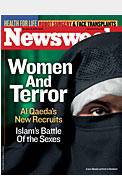
Terror: Women of Al Qaeda


Work on the Newsweek cover story "Women of Al Qaeda" consumed every minute of my time over the last couple of weeks, which is why no new Shadowland column appeared and no new items were posted on this blog. This is a project we've been looking at since last year, the reporting contributions from our farflung correspondents were wonderful, and I'm pleased with the way the story turned out, but I am also convinced that the interrelated questions of sex, gender and jihad have only just begun to be explored:

Cover Story: Women of Al Qaeda, 4 Dec 2005
Jihad used to have a gender: male. The men who dominated the movement exploited traditional attitudes about sex and the sexes to build their ranks. They still do that, but with a difference: even Al Qaeda is using female killers now, and goading the men.

Dec. 12, 2005 issue - Very little is known about the first woman to become a suicide bomber for Al Qaeda in Iraq, except that she dressed as a man. Two weeks after a U.S.-backed operation to clean out the town of Tall Afar near the Syrian border in September, she put on the long white robe and checkered scarf that Arab men commonly wear in Iraqi desert towns. The clothes disguised her gender long enough for her to walk into a gathering of military recruits with no one taking much notice. The clothes also concealed the explosives strapped around her womb. "May God accept our sister among the martyrs," said a Web site linked to the organization of Jordanian-born terrorist Abu Mussab al-Zarqawi. She had defended "her faith and her honor." No name was given. But the bomb that blew apart that anonymous woman killed five men, maimed or wounded 30 more, and opened a new chapter not only in the war for Iraq but in the global struggle against terror....
http://www.msnbc.msn.com/id/10315095/site/newsweek/

Thursday, November 24, 2005

Journalism: Hugh Sidey's Life and Time

The Gentleman Journalist

Hugh Sidey was the last of a breed. Why we will not see his like again.

Newsweek
Updated: 1:47 p.m. ET Nov. 23, 2005

Nov. 23, 2005 - “Gentleman” is not a term used very often to describe a reporter, but for any of us who knew Hugh Sidey, it is likely to be the first word that comes to mind. I had dinner with him just last Sunday here in Paris and was blown away, as always, by his energy, enthusiasm and experience. Hugh started covering presidents of the United States during the Eisenhower years for Life Magazine and then for Time. He met and wrote about every president of the last five decades, and he knew some, John F. Kennedy and George H.W. Bush among them, not only as subjects and sources, but as friends. Born in Iowa, Hugh was a fourth-generation newspaper man from the heartland, confident of his trade, secure about his ethics....
http://www.msnbc.msn.com/id/10181211/site/newsweek/

Terrorism: Tortured Prose and Padilla

Two articles currently posted on the Newsweek Web site deal with the Padilla case:

Isolating Cheney?
The White House change of mind on Padilla is another sign of the deepening rifts in the administration over detainees’ rights
http://www.msnbc.msn.com/id/10183319/site/newsweek/

Case Not Closed
The decision to charge Jose Padilla may not resolve the larger constitutional issues over ‘enemy combatants.'
http://www.msnbc.msn.com/id/10184957/site/newsweek/


Shadowland looked at the Padilla case way back in August 2003:

We Have Ways of Making You Talk
The United States figures it can get plenty out of the newly captured Chemical Ali. But how? And are these ‘interrogation’ techniques being readied for American citizens?

...How do you make a man like this talk? We Americans have ways, it would seem, and they were recently outlined by none other than Vice Adm. Lowell E. Jacoby, director of the Defense Intelligence Agency. No need to get out the battery cables or fingernail pliers, it seems. The only thing Jacoby tortures is prose. “Interrogation is the art of questioning and examining a source to obtain the maximum amount of usable, reliable information in the least amount of time to meet intelligence requirements,” Jacoby writes in a legal brief. “DIA’s approach to interrogation is largely dependent upon creating an atmosphere of dependency and trust between the subject and interrogator.”

Actually, we know from other documents declassified over the years that when it comes to questioning hard cases, dependency is a whole lot more important than “trust.” Suspected bad guys are isolated and dependent for every bit of information they receive, even the time of day. The interrogators have the power to grant or withhold permission for every bodily function, including sleep. It’s amazing how fast most people break down under such circumstances.If that doesn’t work, the treatment can get rough. But you have to read between Jacoby’s lines to figure that out.

Because the enemy in the war on terror is so hard to identify and doesn’t fight the kind of war the United States spent trillions of dollars to wage, Jacoby tells us “innovative and aggressive solutions are required.” A “robust program” has been put in place during which “interrogations have been conducted at many locations worldwide by personnel from DIA and other organizations in the Intelligence Community.”

As one of Jacoby’s subordinates in the U.S. Navy explained to me, the idea is to keep most of the important players out of the United States. Apparently there is no shortage of black holes in which to soften up the bad guys, although only a few are publicized. “The most interesting thing about interrogations is how the U.S. government and military capitalizes on the dubious status (as sovereign states) of Afghanistan, Diego Garcia, Guantanamo Bay, Iraq and aircraft carriers to avoid certain legal questions about rough interrogations,” my friend told me. “Whatever humanitarian pronouncements a state such as ours may make about torture, states don’t perform interrogations, individual people do. What’s going to stop an impatient soldier, in a supralegal location, from whacking one nameless, dehumanized shopkeeper among many?”Not the law, certainly. But should we complain? These American interrogators have worked their magic on some of the very bad actors in Al Qaeda, which is one reason the United States is a little safer today than it was two years ago.

But there are some real problems with all this. First of all, as a Lebanese torturer—er, interrogator—of my acquaintance once told me, the real challenge comes if someone is telling the truth: “How do you know?” And what if that truth doesn’t fit with what you really want to hear? And what your bosses really believe—really know in their souls to be the truth? What if, for instance, there really are no weapons of mass destruction in Iraq because they really were destroyed to keep United Nations inspectors from finding them? The United States now has captured 37 of the 55 most-wanted Iraqis in the famous pack of cards. That’s what all of them are saying, and lesser-known scientists have told the same story. Yet still the WMD beat goes on.

The means of making people talk, even relatively benign means, become problematic when you don’t actually care what they say.

Still, as a freedom-loving American, that’s not what worries me most about Jacoby’s rationale for robust interrogations in faraway places. What worries me is that it was submitted in January to the U.S. District Court for the Southern District of New York to explain techniques used on an American citizen by DIA interrogators after that citizen was arrested and jailed in the United States of America.

The man’s name is José Padilla. Some 15 months ago, Attorney General John Ashcroft commanded worldwide attention when he announced dramatically (on live TV from Russia of all places) that Padilla had been plotting to set off a “dirty bomb” in the United States. Padilla, a high-school dropout and former gang member from Chicago, had drifted into the orbit of Osama bin Laden in Afghanistan and had been persuaded to bring a terror campaign back to the United States. Or, rather, to think about doing it. Or, at least, he surfed the Web trying to find out how he might do it. The FBI questioned him for a month, then handed him over to the Pentagon.

Padilla was declared an “enemy combatant” based on the assertion—not the presentation—of “some evidence” by the administration that he was a bin Laden bad guy....
http://msnbc.msn.com/id/3068190/

Iraq: Khalilzad Babylon

Newsweek's Kevin Peraino has a vivid onscener from the cradle of civilization, such as it is these days:

Nov. 23, 2005 - All kinds of men have come to Babylon, and this week it was U.S. Ambassador Zalmay Khalilzad's turn. The ruins are about a half-hour south of Baghdad—if your chariot, like Khalilzad's, is a Black Hawk helicopter. His convoy flew fast and low, just above the tree line of the date-palm groves, banking and dipping with evasive maneuvers as it approached the ancient city.

Once on the ground, Khalilzad's train of armored Suburbans wove past the amphitheater that Alexander the Great had built—and the massive, dun-colored palace that Saddam Hussein had added. "Think of the tourism potential here," Khalilzad offered as he stopped to take a photo in front of the basalt Lion of Babylon. "One day it could exceed the Iraqi income from oil!"

Khalilzad was just doing his job as America's top diplomat in Iraq: trying to keep any frail spotlight on the nation's "potential," as the rest of the world focused on its all-too-obvious perils. But as Rep. John Murtha prompted a rancorous Washington discourse about when American troops should depart Iraq, diplomats like Khalilzad and the more than 150,000 troops still stationed here could not have helped but feel the intensity of the debate back home. Lawmakers admitted public opinion seemed to be reaching a "tipping point" in the United States, as a majority of Americans—63 percent in a recent Harris poll—now say they favor bringing their troops home by the end of next year....
http://www.msnbc.msn.com/id/10181771/site/newsweek/

Saturday, November 19, 2005

Shadowland: The Terrorist Temptation

As it happens, shortly after Newsweek posted this column the Republican-controlled House of Representatives propped up a straw man and batted it away, voting against "an immediate pullout" from Iraq. This cheap shot was a response to Democratic Congressman John Murtha's address the previous day which proposed to begin a rapid phased withdrawal of American troops. The column is a discussion of why that makes sense:

Shadowland: The Terrorist Temptation, 18 Nov 2005
The Bush administration is so accustomed to torturing the truth, it can't face the facts. Murtha's outburst on Iraq has shown it is time to stop deluding ourselves.

Nov. 18, 2005 - Over a glass of Champagne and under the eyes of raging priests on a vast Old Testament tapestry, I caught up with Paul Wolfowitz in Paris earlier this week. The current World Bank president and former U.S. deputy secretary of Defense, who is seen by many as the architect of the Iraq invasion, was talking mainly about bird flu and development issues in Africa. The cost of fighting the avian-borne pandemic, he said, might be as much as $1.5 billion. He made that sound like an awful lot of money, and probably it is when he’s scrounging for funds from international donors. But since $1.5 billion is about what the United States spends each week in Iraq, I asked Wolfowitz if he didn’t feel a few regrets about that venture.

Wolfowitz has a very pleasant way about him, professorial and quietly passionate. Regrets? No. “It’s extremely important to win the fight in Iraq,” he said. At the cocktail party after the conference in the ornate reception room of a grand palais, I buttonholed Wolfowitz again. We all wanted to get rid of Saddam Hussein, I said, but when it became obvious in 2002 that we didn’t have a decent plan for occupying Iraq, shouldn’t we have thought again? “I think there shouldn’t have been an occupation,” said Wolfowitz. He thought we should have trained more Iraqis to take over. He didn’t elaborate—he was running out the door—but Wolfowitz always thought that Ahmad Chalabi should run post-invasion Iraq.

So the big mistake in Mesopotamia, it would seem, was not following the grand plans of the best and the brightest who took us to war there in 2003. Others failed, not they. And maybe the armchair war-lovers of the Bush administration really believe this. Ideologues see the world through different lenses than ordinary people. From their perches in government or academe, they like to imagine themselves riding the waves of great historical forces. Faced with criticism, they point fingers at their enemies like Old Testament prophets and call down the wrath of heaven.

But there’s no reason the rest of us should delude ourselves, which is one reason, I suspect, that Democratic Congressman John Murtha, a retired Marine colonel and long-time friend of the U.S. military on the Hill, spoke yesterday with such unfettered outrage....
http://www.msnbc.msn.com/id/10099807/site/newsweek/


Also see below,
Iraq: Murtha in His Own Words, which includes some interesting commentary from readers.


Death Squads: "Command Responsibility"

Yesterday a jury in federal court in Memphis, Tennessee, convicted former Salvadoran Deputy Defense Minister Nicolas Carranza of "command responsibility" for crimes against humanity committed by death squads operaing with the support of the U.S.-backed military. Carranza was on the CIA payroll throughout the period in question -- indeed, for 20 years -- and was naturalized as a U.S. citizen in 1985. It took a quarter of a century to bring this infamous immigrant to justice. The people in the United States government who supported him or were apologists for the actions he carried out in the first term of the Reagan administration have never been held to account.

One would love to know more, for instance, about the relationship of now-Deputy National Security Adviser Elliott Abrams with the infamous Col. Carranza. Under Reagan, first as assistant secretary of state for human rights, then as assistant secretary for Inter-American affairs, Abrams was one of the administration's leading dissemblers. He denounced the New York Times report of the infamous Mozote massacre, for instance, as mere communist propaganda. During the Iran-Contra scandals, Abrams lied to Congress. Faced with felony counts for his offense, he copped a misdemeanor plea and subsequently received a pardon from President George H.W. Bush. I suspect that even the shameless Abrams found Carranza distasteful. He may actually have seen him as a liability, since Carranza was such a lighning rod for criticism. But there's still much to be uncovered. Let's hope the Carranza investigations continue on up the line.

For more on the Carranza case, visit the Web site of the Center for Justice and Accountability. Following is an excerpt of the organization's presentation:

Background

The year 1980 in El Salvador was marked by rampant human rights abuses, forced disappearances, arbitrary detention and murder. The Security Forces, working as or with plainclothed "death squads", carried out widespread atrocities against civilians, including opposition political figures, members of labor unions, and people who provided care and education to the public, such as teachers, doctors, rescue workers and priests. Experts estimate that 10,000 to 12,000 unarmed civilians were killed in 1980 alone, including revered Salvadoran Archbishop Romero. CJA filed a separate case against one of the conspirators in the Romero assassination in September 2003.

Colonel Nicolas Carranza, a naturalized U.S. citizen living in Memphis, was Vice-Minister of Defense of El Salvador from late 1979 to early 1981. In that position, he exercised command and control over the three units of the Security Forces - the National Guard, National Police and Treasury Police - that was responsible for widespread attacks on civilians. Despite being removed from his position as Vice-Minister due to U.S. pressure over his human rights record, Colonel Carranza was later brought back in 1983 as head of the brutal Treasury Police. After being forced out of the Treasury Police, Carranza immigrated to the United States in 1985. He became a U.S. citizen in 1991. In 1984, the New York Times reported that Colonel Carranza had been a paid informant for the CIA.

Chavez v. Carranza

Verdict

November 18, 2005. Today, the federal court jury found Memphis resident Colonel Nicolas Carranza, the former Vice-Minister of Defense of El Salvador, responsible for overseeing torture and killings in that country. The verdict is a partial verdict in favor of four of the five plaintiffs. The jury has yet to reach a verdict on the claim of the fifth plaintiff, Ana Patricia Chavez, and is continuing to deliberate.

The verdict represents the first time that a U.S. jury in a contested case has found a commander liable for crimes against humanity. This means that violations were committed as part of a widespread or systematic attack against the civilian population of El Salvador. The jurors awarded each of the four plaintiffs $500,000 in compensatory damages for a total of $2 million.

The jury also recommended that Carranza should pay punitive damages. Additional testimony will be taken today or Monday to determine the precise amount of that award.

The trial was marked by several important revelations. Former U.S. Ambassador to El Salvador Robert White testified that Colonel Carranza was a paid informant for the CIA while he was Vice-Minister of Defense and a member of the High Command in 1980. At that time White asked the CIA station chief in El Salvador to remove Carranza from the CIA payroll because of his deplorable human rights record but no action was ever taken. Carranza admitted on the witness stand that he had been receiving money from the U.S. government since 1965....

http://www.cja.org/cases/carranza.shtml


For my Washington Post coverage of Carranza in the early 1980s, see the Post archives. - CD

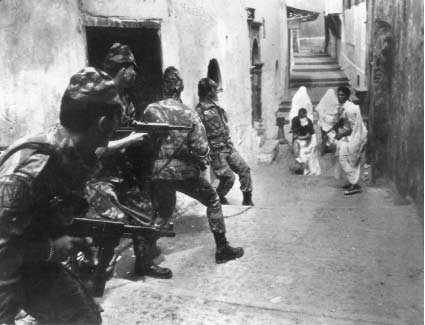
Torture: Reliving the Battle of Algiers

Thanks to Jesse Kornbluth for sending me this translated excerpt from Gillo Pontecorvo's amazing movie about the ambiguities of occupation and torture, "The Battle of Algiers":

A scene in which journalists interview Mathieu,the French colonel who has been sent to Algiers to put down the rebellion:

MATHIEU
Let's try to be precise then. The word "torture" does not appear in our orders. We have always spoken of interrogation as the only valid method in a police operation directed against unknown enemies. As for the NLF, they request that their members, in the event of capture, should maintain silence for twenty-four hours, and then, they may talk. Thus, the organization has already had the time necessary to render useless any information furnished ... What type of interrogation should we choose? ... the one the courts use for a crime of homicide which drags on for months?

3RD JOURNALIST
The law is often inconvenient, colonel ...

MATHIEU
And those who explode bombs in public places, do they perhaps respect the law? When you asked that question to Ben M'Hidi, remember what he said? No, gentlemen, believe me, it is a vicious circle. And we could discuss the problem for hours without reaching any conclusions. Because the problem does not lie here. The problem is: the NLF wants us to leave Algeria and we want to remain. Now, it seems to me that, despite varying shades of opinion, you all agree that we must remain. When the rebellion first began, there were not even shades of opinion. All the newspapers, even the left-wing ones wanted the rebellion suppressed. And we were sent here for this very reason. And we are neither madmen nor sadists, gentlemen. Those who call us fascists today, forget the contribution that many of us made to the Resistance. Those who call us Nazis, do not know that among us there are survivors of Dachau and Buchenwald. We are soldiers and our only duty is to win. Therefore, to be precise, I would now like to ask you a question: Should France remain in Algeria? If you answer "yes," then you must accept all the necessary consequences.

Friday, November 18, 2005

Poll: Goodbye Cruel World

Soon after I began working as a foreign correspondent in Central America, I was forced to the reluctant conclusion that what most people in the United States really want from the rest of the world, if given half a chance, is to forget about it. After September 11, 2001, there was renewed interest in faraway lands, but the implicit promise of the Bush administration as it launched its wars in Afghanistan and Iraq was not to change the world, in fact, it was that the world would not change us. (This has been distilled into the oft-repeated notion that "we're fighting the terrorists there so we don't have to fight them at home.")

Well, every four years the Pew Research Center conducts a poll of what it describes as "the foreign policy attitudes of state and local government officials, security and foreign affairs experts, military officers, news media leaders, university and think tank leaders, religious leaders, and scientists and engineers, along with the general public." The latest just came out, and it shows that out of apathy or disgust, or maybe fear, we're turning our backs on the world once again:

Preoccupied with war abroad and growing problems at home, U.S. opinion leaders and the general public are taking a decidedly cautious view of America's place in the world. Over the past four years, opinion leaders have become less supportive of the United States playing a "first among equals" role among the world's leading nations. The goal of promoting democracy in other nations also has lost ground, and while most opinion leaders view President Bush's calls for expanded democracy in the Middle East as a good idea, far fewer think it will actually succeed.

As the Iraq war has shaken the global outlook of American influentials, it has led to a revival of isolationist sentiment among the general public. Fully 42% of Americans say the United States should "mind its own business internationally and let other countries get along the best they can on their own." This is on par with the percentage expressing that view during the mid-1970s, following the Vietnam War, and in the 1990s after the Cold War ended. ...

http://people-press.org/reports/display.php3?ReportID=263

Iraq: Murtha in His Own Words

It's definitely worth reading the full text of Rep. John Murtha's statement yesterday on the Iraq War:

The war in Iraq is not going as advertised. It is a flawed policy wrapped in illusion. The American public is way ahead of us. The United States and coalition troops have done all they can in Iraq, but it is time for a change in direction. Our military is suffering. The future of our country is at risk. We can not continue on the present course. It is evident that continued military action in Iraq is not in the best interest of the United States of America, the Iraqi people or the Persian Gulf Region.

General Casey said in a September 2005 Hearing, “the perception of occupation in Iraq is a major driving force behind the insurgency.” General Abizaid said on the same date, “Reducing the size and visibility of the coalition forces in Iraq is a part of our counterinsurgency strategy.”

For 2 ½ years I have been concerned about the U.S. policy and the plan in Iraq. I have addressed my concerns with the Administration and the Pentagon and have spoken out in public about my concerns. The main reason for going to war has been discredited. A few days before the start of the war I was in Kuwait – the military drew a red line around Baghdad and said when U.S. forces cross that line they will be attacked by the Iraqis with Weapons of Mass Destruction – but the US forces said they were prepared. They had well trained forces with the appropriate protective gear.

We spend more money on Intelligence than all the countries in the world together, and more on Intelligence than most countries GDP. But the intelligence concerning Iraq was wrong. It is not a world intelligence failure. It is a U.S. intelligence failure and the way that intelligence was misused.

I have been visiting our wounded troops at Bethesda and Walter Reed hospitals almost every week since the beginning of the War. And what demoralizes them is going to war with not enough troops and equipment to make the transition to peace; the devastation caused by IEDs; being deployed to Iraq when their homes have been ravaged by hurricanes; being on their second or third deployment and leaving their families behind without a network of support.

The threat posed by terrorism is real, but we have other threats that cannot be ignored. We must be prepared to face all threats. The future of our military is at risk. Our military and their families are stretched thin. Many say that the Army is broken. Some of our troops are on their third deployment. Recruitment is down, even as our military has lowered its standards. Defense budgets are being cut. Personnel costs are skyrocketing, particularly in health care. Choices will have to be made. We can not allow promises we have made to our military families in terms of service benefits, in terms of their health care, to be negotiated away. Procurement programs that ensure our military dominance cannot be negotiated away. We must be prepared. The war in Iraq has caused huge shortfalls at our bases in the U.S.
Much of our ground equipment is worn out and in need of either serious overhaul or replacement. George Washington said, “To be prepared for war is one of the most effective means of preserving peace.” We must rebuild our Army. Our deficit is growing out of control. The Director of the Congressional Budget Office recently admitted to being “terrified” about the budget deficit in the coming decades. This is the first prolonged war we have fought with three years of tax cuts, without full mobilization of American industry and without a draft. The burden of this war has not been shared equally; the military and their families are shouldering this burden.

Our military has been fighting a war in Iraq for over two and a half years. Our military has accomplished its mission and done its duty. Our military captured Saddam Hussein, and captured or killed his closest associates. But the war continues to intensify. Deaths and injuries are growing, with over 2,079 confirmed American deaths. Over 15,500 have been seriously injured and it is estimated that over 50,000 will suffer from battle fatigue. There have been reports of at least 30,000 Iraqi civilian deaths.

I just recently visited Anbar Province Iraq in order to assess the conditions on the ground. Last May 2005, as part of the Emergency Supplemental Spending Bill, the House included the Moran Amendment, which was accepted in Conference, and which required the Secretary of Defense to submit quarterly reports to Congress in order to more accurately measure stability and security in Iraq. We have now received two reports. I am disturbed by the findings in key indicator areas. Oil production and energy production are below pre-war levels. Our reconstruction efforts have been crippled by the security situation. Only $9 billion of the $18 billion appropriated for reconstruction has been spent. Unemployment remains at about 60 percent. Clean water is scarce. Only $500 million of the $2.2 billion appropriated for water projects has been spent. And most importantly, insurgent incidents have increased from about 150 per week to over 700 in the last year. Instead of attacks going down over time and with the addition of more troops, attacks have grown dramatically. Since the revelations at Abu Ghraib, American casualties have doubled. An annual State Department report in 2004 indicated a sharp increase in global terrorism.

I said over a year ago, and now the military and the Administration agrees, Iraq can not be won “militarily.” I said two years ago, the key to progress in Iraq is to Iraqitize, Internationalize and Energize. I believe the same today. But I have concluded that the presence of U.S. troops in Iraq is impeding this progress.

Our troops have become the primary target of the insurgency. They are united against U.S. forces and we have become a catalyst for violence. U.S. troops are the common enemy of the Sunnis, Saddamists and foreign jihadists. I believe with a U.S. troop redeployment, the Iraqi security forces will be incentivized to take control. A poll recently conducted shows that over 80% of Iraqis are strongly opposed to the presence of coalition troops, and about 45% of the Iraqi population believe attacks against American troops are justified. I believe we need to turn Iraq over to the Iraqis.

I believe before the Iraqi elections, scheduled for mid December, the Iraqi people and the emerging government must be put on notice that the United States will immediately redeploy. All of Iraq must know that Iraq is free. Free from United States occupation. I believe this will send a signal to the Sunnis to join the political process for the good of a “free” Iraq.

My plan calls:

To immediately redeploy U.S. troops consistent with the safety of U.S. forces.
To create a quick reaction force in the region.
To create an over- the- horizon presence of Marines.
To diplomatically pursue security and stability in Iraq

This war needs to be personalized. As I said before I have visited with the severely wounded of this war. They are suffering.


Because we in Congress are charged with sending our sons and daughters into battle, it is our responsibility, our OBLIGATION to speak out for them. That’s why I am speaking out.

Our military has done everything that has been asked of them, the U.S. can not accomplish anything further in Iraq militarily. IT IS TIME TO BRING THEM HOME.

http://www.house.gov/apps/list/press/pa12_murtha/pr051117iraq.html

Thursday, November 17, 2005

CIA: Your Torture Vacation Itinerary


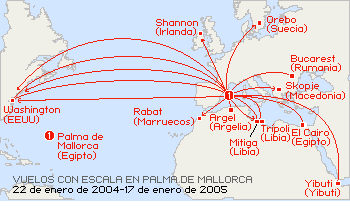
The map from El Pais.


The various routes taken by alleged CIA flights transiting Mallorca.

CIA: Rendition Vacations?

Suspected terrorists may be skinned alive by America's ostensible allies in Iraq, disappear into "black sites" somewhere in Eastern Europe, or be snatched off the streets of Italy to be worked over in Egyptian dungeons, but it's good to know the guys who are doing all this work get a break now and again. We already traced the Agency's penchant for beach and ski resorts in Italy. Now we find that secret CIA fights were making frequent stops in Mallorca going to and from the interrogation centers. The Madrid daily El Pais has given extensive coverage to the case, based on court documents. Among the intriguing details, it seems that about 50 people from the 747s and Gulfstreams that stopped over in La Palma overnighted at the Gran Melia Victoria and the Marriott San Antonem Llucmajor. (I encourage you to click the links and take the "tours.") Remember when the ever-despicable Rush Limbaugh said Guantanamo should be called "Club G'itmo, the Muslim resort"? Probably he'd been hearing tales from the Mallorca crowd and just got confused... - CD

Shadowland background:

Shadowland: Bourne Again?,5 July 2005
The real-life spy adventure uncovered in Italy's "kidnapped imam" case raises more troubling questions about how the Bush administration came to invade Iraq, and what's happened to the war on terror.

Shadowland: The Road to Rendition, 16 June 2005
Did U.S. agents help to abduct an imam off an Italian street? An upcoming Milan case could embarrass both Bush and Berlusconi.

Plamegate: "Completely Implausible"

The clearest narrative I've seen of the events that took us "From Yellowcake to Plamegate" appeared recently in the Christian Science Monitor:

By Peter Grier | Staff writer

WASHINGTON - The first time the State Department intelligence analyst saw the documents he thought there was something weird about them.

The ones dealing with a purported uranium deal between Niger and Saddam Hussein's Iraq bore a validation stamp that seemed a bit funky, for one thing. And that companion paper! It outlined some kind of bizarre military campaign against world powers. Iraq and Iran were supposedly in it together - preposterous, given their enmity - and the whole thing was being run out of the Nigerien Embassy in Rome.

"Completely implausible," the analyst later recounted for investigators.

Because the documents had come from the same source, and were similar in appearance, they were probably all suspect. Maybe now the CIA and the rest of the US intelligence community would believe what the State Department had said for months: These allegations from a foreign intelligence service that Hussein was hunting for "yellowcake" - a uranium concentrate - in Africa were unlikely to be true.

But the CIA didn't look at the documents. A little over three months later President Bush, in his 2003 State of the Union speech, said 16 fateful words: "... the British government has learned that Saddam Hussein recently sought significant quantities of uranium from Africa."

This is the story of how those words came to be, and how their effect rippled through the years, ultimately resulting in the criminal indictment of a high administration official, I. Lewis "Scooter" Libby. Culled primarily from US government reports and congressional testimony, it deals with nuclear materials, foreign spies, and a secret trip to the finest refueling stop in Africa. It centers on a peculiar set of documents - provenance as yet unknown - that a presidential inquiry three years later found to be "transparently forged."...
http://www.csmonitor.com/2005/1115/p01s04-uspo.html?s=yaht

Wednesday, November 16, 2005

Miller: "It's called reporting."

Does the Judy Miller tale feel like old news to you? Does to me. But a colleague sent me this interview from NPR's "On the Media," and the excerpt below seemed to me to be so quintessentially Judy, so smart, so disturbing, that I thought it worth noting:

BOB GARFIELD: By your own retelling, in the New York Times, you said that you agreed in the conversations with Scooter Libby that you would identify him not as a "high White House official" but in fact as a "former [Capitol] Hill staffer," a technical truth. Now, it never showed up in the newspaper but you made an agreement with him to identify him that way.

JUDITH MILLER: No, I did not.

BOB GARFIELD: Am I correct?

JUDITH MILLER: No, you are wrong. I never agreed to identify Scooter Libby in print by that attribution. I only - I agreed to listen to what he had to say under that attribution. If I had ever used that information, I would have gone back to him, as I have done with other sources, and said, "You know, this attribution simply won't fly. Let's talk about an attribution which reflects who you really are but doesn't identify you."

BOB GARFIELD: You said to him, "Yes, I will listen to your story as a former Capitol Hill staffer," and then you let him tell you what he had to tell you. Correct?

JUDITH MILLER: Absolutely.

BOB GARFIELD: And then had you decided to print, then you would go back and try to get him to change the terms of the - [OVERTALK]

JUDITH MILLER: Not try to get him. He would either change the attribution or I wouldn't use the information, or I would go to somebody else for the information and get it confirmed, hopefully on the record, which is what happens all the time in Washington national security reporting.

BOB GARFIELD: Well, then forgive, please, the "do you still beat your wife" question, but if you had no intention of using that attribution that you negotiated, then why have the negotiation to begin with? I mean - [OVERTALK]

JUDITH MILLER: 'Cause I was interested in listening to what the man had to say.

BOB GARFIELD: So one promise you make to your source is so important that you'll go to jail to honor it but another is just a trick to get information.

JUDITH MILLER: No, it's not a trick. It's called reporting. [OVERTALK]

-----

Judy now has her own site: http://judithmiller.org/

Enough said. - CD

Monday, November 14, 2005

History: Love and Death in WWII

The British National Archives have uncovered their monthly trove of fascinating free insights into the shadowlands of history. In November they offer free pdf downloads of documents about American G.I.s and their "girl friends" during the long wait for D-Day.

Also of interest this months:
Sarah Mugabe's application to stay in UK (FCO 36/717) Go to DocumentsOnline to view the images

Harry St John Bridger Philby's detention in India and deportation without legal authority (HO 45/23780) Go to DocumentsOnline to view the images

Randolph Churchill's request for comfort supplies (HS 9/316/2) Go to DocumentsOnline to view the images

Posted by Picasa

Sunday, November 13, 2005

Torture: McCain's Cold Fury

Sen. John McCain, a torture survivor, starts out slow in his essay leading the current issue of Newsweek's domestic edition. But his arguments are solid, and his anger at the Bush administration's record on torture is incandescent:

...
I don't mourn the loss of any terrorist's life. Nor do I care if in the course of serving their ignoble cause they suffer great harm. They have pledged their lives to the intentional destruction of innocent lives, and they have earned their terrible punishment in this life and the next. What I do mourn is what we lose when by official policy or official neglect we allow, confuse or encourage our soldiers to forget that best sense of ourselves, that which is our greatest strength—that we are different and better than our enemies, that we fight for an idea, not a tribe, not a land, not a king, not a twisted interpretation of an ancient religion, but for an idea that all men are created equal and endowed by their Creator with inalienable rights. ...

http://www.msnbc.msn.com/id/10019179/site/newsweek/

The companion piece by Evan Thomas looks at the debate over less-than-fatal means of torture:

... Since 9/11, torture lite has been used by the Americans in the war on terror. In the immediate aftermath of the 9/11 attacks, fearful that another attack was imminent, Vice President Dick Cheney said, "we have to work... the dark side, if you will." Declared the CIA's then Counterterror chief Cofer Black: "After 9/11, the gloves came off." At one point, the Bush administration formally told the CIA it couldn't be prosecuted for any technique short of inflicting the kind of pain that accompanies "organ failure" or "death."...
http://www.msnbc.msn.com/id/10020629/site/newsweek/

Terror: Zarqawi's Global Strategy

Newsweek's Rod Nordland files from Jordan after the bombings:

Nov. 21, 2005 issue - In Washington, D.C., last week, intelligence officials at a brainstorming session debated whether Al Qaeda's top commander had gotten his hands on nuclear materials. In Dublin, U.S. investigators met with counterparts to look into a financier allegedly funneling money to the Qaeda boss. In Amman, Jordan, as three American-owned hotels mopped blood off their floors and hospitals tallied 57 dead from the country's worst terrorist outrage, no one doubted who was to blame: the same Qaeda bigwig. It wasn't Osama bin Laden who had everyone's attention. It was the leader of Al Qaeda in Iraq, Abu Mussab al-Zarqawi...

http://www.msnbc.msn.com/id/10018673/site/newsweek/


Craig Whitlock also covers some of this ground in
The Washington Post. I found the reporting from Germany especially interesting:

.... European security officials have become increasingly worried that, given his increased stature in the Middle East, Zarqawi might begin to shift his focus to the so-called far enemy as well.

Last month, four Zarqawi acolytes were convicted in Duesseldorf of plotting attacks against Jewish targets in Germany in 2002. Testimony showed that some of them were in regular phone contact with Zarqawi and raised money on his behalf.

The presiding judge, Ottmar Breidling, said there was no doubt who was behind the plots. "Abu Musab Zarqawi should also be sitting on the defendants' bench," he said in court.

Zarqawi has been sentenced in absentia to death for other terrorism plots in Jordan.

Some European intelligence officials said they fear that Zarqawi is becoming a galvanizing figure for Islamic radicals and could eventually take the place of bin Laden as the symbolic head of the movement.

August Hanning, president of Germany's foreign intelligence service, said there were signs of increased numbers of Islamic extremists going to Iraq from Europe to fight for Zarqawi, not because his network had recruited them directly, but merely because his success inspired them to join.

"He functions as a role model. There are groups that believe it is a great honor to be able to carry out attacks in his name," Hanning said at the Berlin conference Thursday. "We have seen how numerous groups, who -- on their own initiative -- have tried to make contact with Zarqawi to work together." ...

Readers of the Shadowland columns will find all of this familiar territory:

Newsweek: Jihad Express, 13 Mar 2005
For Islamic Militants in Europe, Iraq far outshines Afghanistan as an urban-terrorism training ground.
http://www.msnbc.msn.com/id/7169294/site/newsweek/

Cover story: Unmasking the Insurgents, 30 Jan 2005
Shadow war: The elections won't stop the bombers, but quality intel -- and luck -- might help. http://www.msnbc.msn.com/id/6885867/site/newsweek/


Shadowland: The Executioner's Song, 20 Oct 2004
With just a small support base, Abu Mussab al-Zarqawi used the Web to build himself up into a mythical jihadist. http://www.msnbc.msn.com/id/6289451/site/newsweek/

Shadowland: Italy's Sleeper Cells, 20 Aug 2004
The threat of an Al Qaeda attack there is real—and growing.
http://www.msnbc.msn.com/id/5772911/site/newsweek/

Shadowland:
The Iraqi Horror Picture Show, 12 May 2004
Managing information and uncovering facts are two very different things.
http://msnbc.msn.com/id/4963119/

Newsweek:
Has the War Made Us Safer?, 3 April 2004
Iraq has become a savage battleground -- part of the world's first global insurgency. Time is running short to fix that. http://www.msnbc.msn.com/id/4661300/

Shadowland: A (Terrorist's) Letter from Iraq, 17 Feb 2004
The so-called Zarqawi memo may or may not be genuine, but it's a revealing picture of Iraq right now. http://www.msnbc.msn.com/id/4253025/


Europe: Race and Rage

The latest from the banlieues and beyond:

Newsweek Int'l Cover: Europe's Time Bomb, 13 Nov 2005
The French riots should be a wake-up call for all Europe. What's long been considered 'normal' is no longer socially or politically sustainable.

...The core of the time bomb is demography, and the detonator is racism. The native populations of Europe—let's say it, the white populations—are reproducing slowly and aging fast. Without continued immigration, according to the European Union and United Nations statistics, by 2050 the number of Germans will have shrunk from 83 million to 63 million; Italians will go from 57 million to 44 million. In the same period, among the North African and Middle Eastern countries surrounding Europe, the population will double....

From the international edition of the magazine: http://www.msnbc.msn.com/id/10019180/site/newsweek/
A shorter version from the domestic US edition:

Thursday, November 10, 2005

France: Waning Riots in Perspective

There's a chill in the air and on the streets, at least for now --

Online dialogue with Newsweek readers about the situation in France, 9 Nov 2005
http://www.msnbc.msn.com/id/9934502/site/newsweek/

Jordan: Who and Why (Audio)

A lot of bad news out there ...

Newsweek Audio: Jordan Attacked, 9 Nov 2005
Newsweek's Christopher Dickey reports on the bombings in Amman, a longtime ally to Washington. http://www.msnbc.msn.com/id/9980646/site/newsweek/

Sunday, November 06, 2005

Italy: Secret Documents, Public Statements

I had an interesting time in Rome a couple of weeks ago exploring the Italian connection with the Niger-Iraq-Nuclear issue. While I was there I spent the better part of an hour with Romano Prodi, seen by many as the once-and-future prime minister of Italy. He was in a great mood when we met near Piazza Venezia, where anti-Berlusconi protesters were making so much noise that, even in his office, Prodi sometimes had to raise his voice to be heard. The Newsweek interview hits most of the high points. But there was one issue that took a little too much explanation to get into the magazine's Q&A format. I wanted to know what Prodi thought of the series of articles that had just appeared in La Repubblica linking the Italian military intelligence service, SISMI, to bogus reports that Niger had sold processed uranium to Saddam Hussein in 2000. "I don't call this exchange of information," said Prodi. "I call this exchange of disinformation."

I am afraid the background to all this, which is central to the way the U.S. administration made its case for war, is not very well known to American readers. A piece last week by Elaine Sciolino and Elisabetta Provoledo in the New York Times, "Source of Forged Niger-Iraq Documents Identified," condescendingly called the Repubblica version "breathless," probably because it was seized on so avidly by some bloggers in the United States as yet another smoking gun to indict the White House. The Times article repeated the Berlusconi government's official line that it had nothing to do with the faked Niger dossier, no way, no how, and suggests that an FBI investigation -- which we haven't seen -- exonerates the Italian services.

Following are some of my own notes on the
Repubblica
pieces, essentially a rough translation, pointing out some of the holes, but also some of the new leads:

The saga that led to this afternoon’s indictment [of Libby] dates back about six years, according to an exhaustive investigation published this week by the Italian newspaper La Repubblica and co-reported by former Newsweek intern and stringer Carlo Bonini.

In 1999 and 2000, French officials were concerned that uranium was being stolen or smuggled from the mines they run in Niger, and naturally they wanted to know anything they could in order to stop it. A shady Italian figure named Rocco Martino got wind of French concerns and started fishing around for something to sell them.

Martino is “a failed carabinieri,” a 67-year-old former low-level spook who was fired from his job as a captain in Italy’s political-military intelligence service in the 1970s, according to La Repubblica. In 1985 Martino was arrested in Italy for extortion, the paper says. In 1993 he was arrested in Germany with stolen checks, the paper reported, yet he apparently continued some sort of collaboration with Italian military intelligence (SISMI) until the end of 1999.

“He plays a double game,” says the first of the La Repubblica articles published this week. Martino supposedly lives in Luxembourg (3, rue Hoehl, Sandweiler) and receives a subsidy from French intelligence supporting his consultancy called “Security Development Organization Office.” But according to the newspaper, Martino worked for both the French and the Italians, selling French news to Rome and Italian news to Paris. “This is my métier,” Martino told La Repubblica. “I sell information.”

Now, it’s important to remember that the origins of the Niger story date to before 9/11, and even before George W. Bush was elected. In fact, Saddam Hussein’s relations with Niger and his supposed interest in its uranium had been raising alarms in some circles since the 1980s, when he had a very aggressive secret nuclear program. The Italians had played a role trying to stop at least two suspect Iraqi operations back then. They had managed to put their hands on some of Niger’s codes and a telex of Amb. Adamou Chékou informing his foreign ministry in Niamey, Niger, about the mission of Wissam al-Zahawie, the Iraqi ambassador to the Holy See, as “representative of Saddam Hussein.” There was also an operation at Trieste where the Italians managed to seize high-tensile “marangin” steel that was supposed to be used in centrifuges. But that was all very old news – from before Saddam’s defeat in 1991 and the UN inspections that eventually uncovered his entire secret project to build the bomb.

At the end of 1998, as part of a showdown with Saddam, the UN had pulled out all of its inspectors. By 1999 it was generally assumed that Saddam would try to re-start his WMD programs. Indeed, such assumptions would take us to war in 2003. But there was no proof and, as we know now, the assumptions were wrong.

Martino was looking for something that he could sell for a good price in 1999 or 2000, La Repubblica reported. If he could pick up that old Iraq-Niger connection, the French presumably would be interested – and so would lots of other people. So Martino went to an old friend, Antonio Nucera. Like Martino, Nucera was a former carabinieri, but he was still with SISMI, working as head of a unit looking at arms trafficking and counterproliferation issues in Africa and the Middle East. Judicial officials have confirmed to Newsweek that Nucera put Martino in touch with a source inside the Niger embassy in Rome. The head of SISMI, Nicolò Pollari, told La Repubblica, “Nucera wanted to help his friend, so he invites a Source of the Service … to give a hand to Martino.” This source was a sixty-something woman working at the Niger embassy. She also needed money, according to Repubblica. She suggested the diplomat in the embassy who might be most useful to Martino and Nocera: First Counselor Zakaria Yaou Maiga. Apparently he liked the good life. Pollari told Repubblica that “Maiga spends six times what he gains.” Maiga is no longer in Rome.

According to Repubblica, Maiga waited for the embassy to close for New Year’s 2001 and staged a break-in. The next day, another Niger functionary notified the carabinieri that there’d been a theft, but didn’t say that in fact official embassy stationery and official stamps were missing. They would be used to prepare a “letter of intent” between Niger and Iraq “concerning the supplying of uranium initialed the 5th and 6th July 2000 at Niamey,” according to Repubblica. Martino then sold this package to France’s Direction Générale de la Sécurité Extérieure (DGSE), which quickly concluded they were crap. Among other things, the Niger officials supposedly involved in the transactions were no longer in office.

This was early 2001, and the story might have ended there. Then September 11 happened, and the Bush administration quickly started turning its attention to Iraq and the supposed threat posed by its weapons of mass destruction. In the meantime, faces were changing at SISMI. Pollari took over at the top. Meanwhile, the relatively low-ranking Nucera was retiring, according to Repubblica.

What we do not know, and Rebubblica does not know, is precisely when SISMI, as such, got a hold of the fake Niger dossier. Did Martino pass it along at the same time he sold it to the French? This is not clear, and Bonini could not get any of his sources to give a firm answer. But it did show up in CIA traffic in October 2001.

The central “accusation” of the Repubblica pieces is that SISMI knew the documents were fake, and allowed or even encouraged their dissemination. But this is an inference based on circumstance rather than a point that’s been proved.

Repubblica quotes Rocco Martino saying, “At the end of 2001, SISMI transmitted the yellowcake dossier to the English of MI6. They ‘passed’ it without assessment, saying only that it was received from ‘a reliable source.’” Martino is also quoted saying, “SISMI wanted to disseminate the Niger dossiers to allied intelligence, but, at that time, didn’t want its involvement in the operation to be known.” But Martino was not necessarily in a position to know this. Berlusconi’s spokesmen have since dismissed these accusations by Martino and insisted that “no dossier about uranium, neither directly nor through intermediaries, has been consigned or made to be consigned to anyone.”

According to Repubblica, Greg Thielman at the State Department’s Bureau of Intelligence remembers seeing a digest of the supposed contents of the dossiers, sent over from Langley, which had gotten it from its field officer in Italy dated Oct. 15, 2001. The officer said he had seen the Italian documentation, which suggested an Iraqi attempt to acquire 500 tons of pure uranium from Niger. Also in the fall of 2001 (although dates unclear) Michael Ledeen showed up in Rome. He apparently was an acquaintance of Defense Minister Antonio Martino (no relation to Rocco), and Minister Martino asked Pollari to see Ledeen “as an old friend of Italy.” Repubblica says Ledeen was in Rome at the behest of the Office for Special Plans, but I’m not sure about this. It also says he’d been deemed undesirable by the Italian government since the 1980s. Don’t know what that was about. Repubblica quotes an unnamed official saying Pollari had gotten a cold reaction to the Niger documents from the CIA station chief in Rome, and decided not to see Ledeen. It’s not clear if Ledeen picked up on the documents while in Rome, whether from SISMI or another source.

By early 2002, Cheney knows the Niger story, at least in part, and wants to know more. In February 2002, Wilson -- who was a former ambassador to Gabon, who was DCM in Baghdad on the eve of the 1991 Gulf War, and who is the husband of Valerie Plame -- is being dispatched to check out the story in Niger. He comes back and reports the story doesn't seem credible.

Never mind. By the first anniversary of the Sept. 11 attacks on New York and Washington, the Bush campaign for war against Iraq was moving ahead full steam, especially in the press, and the Italians seem to have been doing everything they could to be helpful. Were they so anxious to please that they just couldn’t bring themselves to mention that the documents were fake? Or did the Bush administration not want to know? These questions are at the core of the Repubblica stories, but they are not answered. Nor is the biggest question: to what extent was disinformation being disseminated by design?

Repubblica focuses attention on a meeting set up on Sept. 9, 2002, by Gianni Castellaneta, who was then the diplomatic adviser to Berlusconi and is now the Italian ambassador to Washington. Pollari was in Washington and paid what is now described by the NSC as a courtesy call of less than 15 minutes on Stephen Hadley, who was then Condi Rice’s number two.

The timing is interesting because the administration’s propaganda offensive was so intense at just that moment. Judy Miller’s infamous story about centrifuge parts (actually, rocket parts) had appeared just the day before with the famous quote from an anonymous official saying we didn’t want to have the next smoking gun be a mushroom cloud. More to the point, the Berlusconi-owned news magazine Panorama was just putting to bed a "scoop" headlined "The War? It's Already Begun," describing the shipment of "half a ton of uranium" to Iraq. The report said "The men of the Mukhabarat, the Iraqi secret police, had acquired it through a Jordanian company in faraway Nigeria [sic], some merchants had smuggled it after getting it out of the nuclear stores of a former Soviet republic. 1,500 kilos of uranium were taken to Amman, and from there, overland, arrived after a seven hour trip at their destination: an installation 20 kilometers north of Baghdad named Al Rashidiya, known for the production and processing of fissile material." Not clear what, if any, sourcing Panorama claimed for that muddled revelation, which seems to have confused Niger and Nigeria.

Pollari, back in Rome from his visit to D.C., testified before the Italian parliament’s intelligence oversight committee. In the first of two appearances, he said “We don’t have documentary proof, but information that a central African country has sold pure uranium to Baghdad.” Thirty days later, Pollari said, “We have the documentary proof of the acquisition of natural uranium in a central African republic on the part of Iraq.”

It’s at about this point that Rocco Martino gets in touch with Elizabetta Burba, a correspondent for Panorama, and tries to sell her the by now rather tired documents. She does some basic due diligence and concludes they’re “bufala.” But her editor, Carlo Rossella, meanwhile passes the documents along to the station chief at the US embassy with the rationale that he’s the best person to verify them. It’s the same crap the COS thought had little merit the year before, but in a slightly different package. Another report makes its way back to Washington, but seems to have gotten, er, misplaced inside the agency. Meanwhile, however, the myth endured – one might say it was cultivated – in other parts of the administration, and in Britain, before becoming 16 words in the president’s State of the Union address in 2003.

A final thought: it’s striking the way the supposed case for Saddam’s nukes kept coming back to two questions: Niger uranium and centrifuge parts – the same two elements that had been floating around since the 1980s. Not sure what that signifies, apart from a conspicuous lack of imagination by the fabricators.

end